


The real test has a personality: pacing, phrasing, pressure. The 76 Q&As covering the Databricks Certified Machine Learning Associate objectives rehearse you against that personality until the Databricks-Machine-Learning-Associate exam feels familiar.
Databricks Databricks-Machine-Learning-Associate Exam Syllabus Topics:
| Section | Weight | Objectives |
|---|---|---|
| Topic 1: Databricks Machine Learning | 38% | - Databricks ML Capabilities
|
| Topic 2: Model Deployment | 12% | - Production Deployment
|
| Topic 3: Model Development | 31% | - Building and Training Models
|
| Topic 4: ML Workflows | 19% | - Machine Learning Lifecycle
|
Databricks Certified Machine Learning Associate FAQ: The Useful Parts
First-line service, around the clock: free online consultation whenever a question stalls you, remote guidance for installation or usage issues, and clear answers to content questions by email. On privacy, the rules are rigid — transactions are secured by McAfee security services, purchase information is never disclosed to third parties, and no spam or telemarketing follows your order.
The figures in the overview table above turn into strategy once you treat them as a budget: total time divided by total questions is your per-item allowance, and anything costing double gets flagged for a final sweep instead of a mid-exam standoff. Build the habit under a live timer — GuideTorrent's engine sessions enforce one — so the real clock feels like a rehearsal, not a surprise.
The blueprint above spans 4 domains — treat its weightings as a budget. A domain worth 12% of the score earns a matching share of your week, while lighter areas like ML Workflows get maintained, not marathoned. Walk the full topic list domain by domain, and let the percentages decide where your practice hours land first.
Think of the Databricks-Machine-Learning-Associate exam as Databricks asking for proof, not promises: pass it, and you hold the ML Data Scientist certification, a credential at the Associate level. The questions are built to measure applied skill across the Databricks Certified Machine Learning Associate objectives — the kind employers hire for. It also sits within a broader certification family covering Databricks Certified Machine Learning Professional, Databricks Certified Data Engineer Associate, so one exam's effort keeps paying into the next.
Yes. GuideTorrent's free Databricks Certified Machine Learning Associate PDF demo contains genuine sample questions with verified answers, so you can judge the quality with your own eyes. Every purchase includes 365 days of free updates, and renewing after expiry costs 50% of the regular price from your member zone. Judge first — material this confident has nothing to hide.
Work in passes, not one grind. First pass: untimed, through all 76 questions, marking weak domains against the blueprint above. Second pass: timed engine sessions, reviewing every error the same day while the reasoning is fresh. Final pass: re-test only your flagged items until they stop being wrong. Book the exam when your timed scores hold steady — not when your calendar gets impatient.
The fee shown above is the price of one attempt — and of every retake, at full price. So the passing score is best treated as a floor you clear with margin: work through GuideTorrent practice questions until your timed results sit comfortably above it several sessions in a row, then register. Hours of over-preparation are cheaper than a second registration.
The same 76 expert-written questions ship in all three — you're choosing how you want to live with the material:
- PDF version — the most popular choice: printable, instantly downloadable, ready for handwritten notes anywhere.
- Desktop Test Engine — for Windows users: recreates the real exam atmosphere with two practice modes and full offline access.
- Online Test Engine — app-like access from any browser on Windows, Mac, Android, or iOS, with test history and performance review.
Each version has its own strengths; many candidates mix them — PDF for reading, an engine for timed rehearsal.
Delivery first: your Databricks Certified Machine Learning Associate practice questions are downloadable immediately and emailed within one minute of payment — if 2 hours pass, check spam and contact support. Install on as many computers as you need. If the exam goes wrong, the 100% Money Back Guarantee applies under clear conditions: take the corresponding exam within 60 days of purchase, and if you don't pass, submit a scanned enrollment slip and your official Score Report PDF within 2 days after the exam — full refunds process within 7 days. Not eligible: attempts within 3 days of purchase, exams never actually taken, free items, and expired orders; candidate name must match payer name. Prefer to keep going? Exchange for two free products of equal value and keep your update service.
Databricks Certified Machine Learning Associate Sample Questions:
A data scientist has defined a Pandas UDF function predict to parallelize the inference process for a single-node model: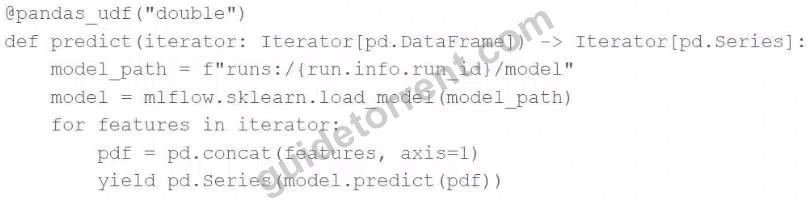
They have written the following incomplete code block to use predict to score each record of Spark DataFrame spark_df: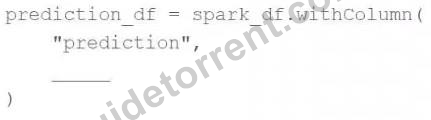
Which of the following lines of code can be used to complete the code block to successfully complete the task?
- A. predict(Iterator(spark_df))
- B. mapInPandas(predict)
- C. mapInPandas(predict(spark_df.columns))
- D. predict(*spark_df.columns)
- E. predict(spark_df.columns)
Correct Answer: B 🗳️
Explanation: Only visible for GuideTorrent members. You can sign-up / login (it's free).
A machine learning engineer is converting a decision tree from sklearn to Spark ML. They notice that they are receiving different results despite all of their data and manually specified hyperparameter values being identical.
Which of the following describes a reason that the single-node sklearn decision tree and the Spark ML decision tree can differ?
- A. Spark ML decision trees test more split candidates in the splitting algorithm
- B. Spark ML decision trees automatically prune overfit trees
- C. Spark ML decision trees test a random sample of feature variables in the splitting algorithm
- D. Spark ML decision trees test every feature variable in the splitting algorithm
- E. Spark ML decision trees test binned features values as representative split candidates
Correct Answer: E 🗳️
Explanation: Only visible for GuideTorrent members. You can sign-up / login (it's free).
Which of the following evaluation metrics is not suitable to evaluate runs in AutoML experiments for regression problems?
- A. MSE
- B. MAE
- C. F1
- D. R-squared
Correct Answer: C 🗳️
Explanation: Only visible for GuideTorrent members. You can sign-up / login (it's free).
A data scientist has a Spark DataFrame spark_df. They want to create a new Spark DataFrame that contains only the rows from spark_df where the value in column discount is less than or equal 0.
Which of the following code blocks will accomplish this task?
- A. spark_df.filter (col("discount") <= 0)
- B. spark_df[spark_df["discount"] <= 0]
- C. spark_df.loc[:,spark_df["discount"] <= 0]
- D. spark_df.loc(spark_df["discount"] <= 0, :]
Correct Answer: A 🗳️
Explanation: Only visible for GuideTorrent members. You can sign-up / login (it's free).
A machine learning engineer wants to parallelize the inference of group-specific models using the Pandas Function API. They have developed the apply_model function that will look up and load the correct model for each group, and they want to apply it to each group of DataFrame df.
They have written the following incomplete code block:
Which piece of code can be used to fill in the above blank to complete the task?
- A. groupedApplyInPandas
- B. applyInPandas
- C. predict
- D. mapInPandas
Correct Answer: B 🗳️
Explanation: Only visible for GuideTorrent members. You can sign-up / login (it's free).
Viewing page 1 out of 16 pages.
Viewing questions 1-5 out of 76 questions.


