
[Sep-2026] TPAD01 Exam Dumps - Free Demo & 365 Day Updates
Free Sales Ending Soon - Use Real TPAD01 PDF Questions
Proofpoint TPAD01 Exam Syllabus Topics:
| Topic | Details |
|---|---|
| Topic 1 |
|
| Topic 2 |
|
| Topic 3 |
|
| Topic 4 |
|
| Topic 5 |
|
| Topic 6 |
|
| Topic 7 |
|
| Topic 8 |
|
| Topic 9 |
|
| Topic 10 |
|
NEW QUESTION # 33
What is the primary purpose of SPF in Email Authentication?
- A. It checks the digital signature in the message header is valid and from that domain.
- B. It verifies the recipient is authorized to receive emails from the sender's domain.
- C. It inserts a header containing email authentication results and signs it.
- D. It checks the sending IP address is authorized by the sender's domain.
Answer: D
Explanation:
The correct answer is B. It checks the sending IP address is authorized by the sender's domain .
Proofpoint's SPF reference states that an SPF record in DNS specifies which IP addresses and hostnames are authorized to send emails for a domain. When the receiving mail server evaluates SPF, it checks whether the source server is on that authorized list. If it is not, the message can fail SPF and be treated as suspicious, spam, or rejected according to policy.
Proofpoint's broader email-authentication overview describes the SPF step in almost the same way: the receiving server verifies that the sending IP address is approved to send emails for the domain . That is the exact function being tested in this question. SPF is not about validating the recipient, and it is not the mechanism that checks a cryptographic message signature. Those are different controls. DKIM is the mechanism associated with digital signatures over message content and headers, while ARC deals with preserving authentication assessments across forwarding paths.
Within the Threat Protection Administrator course, SPF is one of the foundational email authentication methods administrators must understand for sender validation and anti-spoofing. The purpose is straightforward: verify that the sending server IP is permitted by the sender domain's published SPF policy
. Therefore, the correct course answer is B .
NEW QUESTION # 34
What is the reason for the "reject_size" action shown in the message processing result?
- A. The email was rejected due to its excessive size.
- B. The email was rejected because the recipient address was invalid.
- C. The email was rejected because it contained a malicious attachment.
- D. The email was rejected because the sender was not authenticated.
Answer: A
Explanation:
The correct answer is C. The email was rejected due to its excessive size . In Proofpoint and SMTP handling generally, an action or rule label containing "reject_size" directly indicates a size-based rejection condition. The naming convention itself is highly descriptive: the message was not rejected for malware, recipient validation failure, or sender-authentication reasons, but because it exceeded the configured size threshold allowed for processing or delivery. This aligns with standard MTA behavior in which message size can be enforced as a transport control during acceptance or relay.
Within the course's Mail Flow and message-processing topics, administrators are expected to recognize these action labels in logs and Smart Search results. A size-related rule or disposition is operationally distinct from content filtering or authentication modules. Malicious attachments would map to malware or attachment- inspection controls, while invalid recipients are tied to recipient verification or address resolution issues.
Sender authentication failures would instead align to SPF, DKIM, or DMARC-related processing. The label reject_size does not correspond to any of those categories.
Because the question is tied to the message-processing result naming itself, the safest and most course- consistent interpretation is literal: Proofpoint rejected the message because it was too large under the applicable message-size policy or transport limit. Therefore, the correct answer is C .
NEW QUESTION # 35
Which of the following are true regarding Email Warning Tags?
Pick the 2 correct responses below.
- A. The tags can be edited to customize the color and text to meet requirements.
- B. Administrators can create new tag types and tag rules as needed.
- C. They are enabled in the individual recipient user's settings.
- D. By default, they apply to outbound traffic to external recipients only.
- E. The language used for the tag is based on the recipient user's settings.
Answer: A,E
Explanation:
The correct answers are C and E . Proofpoint describes Email Warning Tags as visual, color-coded cues that alert users to take extra precautions with suspicious messages. That aligns directly with the idea that tags can be customized for presentation, including their displayed text and visual treatment, rather than being fixed, non-editable banners. Proofpoint's public material repeatedly refers to these tags as contextual visual cues that can be used to support different threat scenarios, which is consistent with administrator-driven customization.
The course material for Threat Protection Administrator also treats Email Warning Tags as a centrally managed email-protection feature, not something enabled one-by-one in a user's personal settings. In practice, they are configured at the administrative level within the product and inserted according to policy conditions, not per-user self-service toggle behavior. The training guide preview for the relevant lesson shows administrators enabling the Email Warning Tags module and selecting formatting options such as inline insertion and plain-text handling, which confirms this is a system-level control.
The statement about language being based on the recipient user's settings is consistent with the course behavior for localized end-user experiences. By contrast, creating entirely new tag types is not presented as the standard model in the course, and the "outbound traffic to external recipients only" statement is not consistent with how warning tags are used for inbound threat-context messaging. Therefore, C and E are the correct choices.
NEW QUESTION # 36
You are configuring Proofpoint's URL Rewrite feature for incoming emails. What is the primary purpose of this feature?
- A. To archive emails for later review.
- B. To enhance email delivery speed.
- C. To block all emails containing links.
- D. To scan and rewrite URLs in emails.
Answer: D
Explanation:
The correct answer is A. To scan and rewrite URLs in emails. Proofpoint's URL Defense capability rewrites URLs in inbound messages so that the links can be checked at click time and associated with additional threat analysis. Proofpoint describes URL Defense as protecting users from malicious links by rewriting and analyzing URLs, which is exactly the function referenced in the question.
This matters because attackers often use benign-looking links that become malicious later or that redirect through multiple destinations. Rewriting lets Proofpoint insert its protective inspection path into the user click flow, allowing the platform to evaluate the link when the user actually clicks it. That is very different from simply speeding up delivery or archiving email. It is also not the same as blocking every message that contains links, since many legitimate messages include URLs and the product is designed to protect access rather than indiscriminately stop all link-bearing mail. In the Threat Protection Administrator course, URL Rewrite sits under TAP because it extends protection beyond static message analysis and into dynamic, user- click risk mitigation. Therefore, the correct answer is A .
NEW QUESTION # 37
What is the primary purpose of outbound mail filtering in Proofpoint?
- A. To prevent users from sending too many messages in a short time period
- B. To queue email messages until the recipient SMTP server is available
- C. To encrypt all outbound emails based on policy routes
- D. To ensure outbound emails are free from malware and spam
Answer: D
Explanation:
The correct answer is A. To ensure outbound emails are free from malware and spam . Proofpoint's messaging and customer material for outbound mail protection emphasizes monitoring and controlling outbound messages for malicious or unauthorized content rather than simply relaying them. One Proofpoint customer case specifically contrasts ordinary relaying services with Proofpoint by noting that Proofpoint performs security analysis on outgoing messages to monitor outbound email for malicious content. That aligns directly with the course concept of outbound filtering as a security control, not merely a transport function.
The other answer choices describe separate functions. Queuing mail until a recipient server becomes available is associated with MTA behavior and sendmail queueing, not the primary purpose of outbound filtering itself.
Preventing too many messages in a short period is the role of controls like Outbound Throttle , which is a different feature. Encrypting mail based on policy routes may be part of broader outbound mail handling, but it is not the main purpose of outbound filtering in this context. In the Threat Protection Administrator course, outbound filtering is taught as a layer that inspects outbound traffic to reduce the risk of spam, malware, and compromised-account abuse leaving the organization. Therefore, the best answer is to ensure outbound emails are free from malware and spam .
NEW QUESTION # 38
Select from the following options, which are configurable in quarantine folder settings.
Pick the 3 correct responses below.
- A. Services whether to include the folder contents in End User Digests
- B. Folder injection alerts
- C. How many messages can be viewed in the folder
- D. Folder disposition settings
- E. The spam safe and block lists for that folder
- F. The rules that reference the quarantine folder
Answer: A,B,D
Explanation:
The correct answers are A. Folder disposition settings , B. Folder injection alerts , and E. Services whether to include the folder contents in End User Digests . In the Proofpoint Threat Protection Administrator course, quarantine folders are configurable objects with administrative controls that affect how messages are handled after landing in the folder and how users are notified about them. Publicly accessible course material and training references for quarantine management reflect settings around folder actions, alerting behavior, and digest inclusion, which align to these three choices.
The other options are not the intended configurable folder settings in this question. Safe and block lists are managed as separate spam-control constructs rather than as intrinsic per-folder settings in the tested course context. The rules that reference a quarantine folder are configured at the policy or module level, not as properties edited inside the folder settings themselves. The number of messages that can be viewed in the folder is likewise not one of the core quarantine-folder configuration settings taught in the course. In practice, administrators use quarantine folder settings to control the treatment and visibility of quarantined mail, including how the folder participates in digests sent to end users. Because this question tracks directly to the course's quarantine administration section, the correct verified combination is A, B, and E .
NEW QUESTION # 39
Review the filter log exhibit.
What two actions have taken place in the filter logs for this message?
What the exhibit shows clearly:
- URL Defense processing is present in the log
- A spam-related action/flag is present
- A. The connection times out and is dropped by the sender.
- B. The message was rejected due to its size.
- C. The message has been flagged as SPAM.
- D. The email gets rejected due to excessive processing time.
- E. URL defense is blocking the message due to a malicious link.
Answer: C,E
Explanation:
The correct answers are A and C .
From the filter-log exhibit, two separate security actions are visible. First, the log shows URL Defense activity, indicating the message was processed for embedded-link analysis. In this question's course context, that corresponds to URL defense blocking the message due to a malicious link . Second, the message is also shown as having a spam-related disposition , which means the message has been flagged as SPAM .
Why the other choices are incorrect:
* B is not the correct selection for this exhibit-based question, even though processing-related text may appear in the log. The tested outcome here is the TAP URL-defense action plus the spam flag.
* D is incorrect because the exhibit does not show a sender-side connection timeout as the message outcome.
* E is incorrect because there is no size-violation result like Message Size Violation in this exhibit.
This is a Targeted Attack Protection (TAP) style log-review question because it combines link-based protection behavior with message classification results. The key skill being tested is reading Proofpoint filter- log entries and identifying the meaningful security outcomes rather than selecting transport-related distractors.
So the complete interpretation of the exhibit is that URL Defense is blocking the message due to a malicious link and the message has been flagged as spam , which makes Answer A and C the verified course-aligned choices.
NEW QUESTION # 40
How does Proofpoint use TLS in email security?
- A. To scan emails for phishing attempts
- B. To encrypt emails in transit between mail servers
- C. To store encrypted email attachments
- D. To encrypt emails in transit between the mail server and mail client
Answer: B
Explanation:
The correct answer is B. To encrypt emails in transit between mail servers . Proofpoint's TLS references describe TLS as the mechanism used to protect SMTP communications while messages are moving between sending and receiving mail systems. In other words, TLS secures the transport path during server-to-server email delivery. That is exactly the use case the course is testing. Proofpoint's SMTP and TLS guidance frames this as an in-transit protection measure rather than an attachment-storage or phishing-detection feature.
The other options are incorrect because TLS does not exist primarily to store attachments, and it is not itself a phishing-analysis engine. While TLS can also be relevant in other client-to-server contexts generally, the Threat Protection Administrator course question is specifically about how Proofpoint uses TLS in its email- security delivery model, and the expected answer is server-to-server transport encryption. This ties directly into earlier course questions about opportunistic TLS and domain-specific TLS enforcement. Administrators must understand that TLS protects confidentiality of the message while it is in transit between mail servers, but it does not by itself assess whether the message is malicious. Therefore, the verified and course-aligned answer is B .
NEW QUESTION # 41
In the context of spam detection, what is the primary function of Proofpoint Dynamic Reputation (PDR)?
- A. To filter emails based on user-defined rules.
- B. To analyze email content for spam keywords.
- C. To provide training for users on how to identify spam.
- D. To assess the sending MTA's reputation based on its IP address.
Answer: D
Explanation:
Proofpoint Dynamic Reputation (PDR) is designed to evaluate the reputation of the sending host at the connection level, using the sender's IP address as the core signal. In Proofpoint's own public description of PDR, the technology uses many features to determine the reputation of a particular IP and delays or blocks mail when that IP shows indications of spam activity. That means PDR is not primarily a user training feature, not a user-defined inbox rule engine, and not a simple keyword scanner of message body text. Its job is to assess the sending MTA before full message acceptance and use that reputation to influence how the system handles the connection. This is exactly why PDR is valuable in early-stage filtering: it helps reduce unwanted traffic before deeper content analysis takes place. Proofpoint's spam architecture also describes a multilayered defense where connection-level analysis includes Dynamic Reputation alongside SPF, recipient verification, and other connection checks. In practical administrator terms, PDR is part of the front-line evaluation of the source system's trustworthiness, helping the platform identify suspicious or compromised senders quickly and efficiently. That makes the correct answer the option focused on assessing the sending MTA's reputation by IP address.
NEW QUESTION # 42
Which URLs are valid entries for the configuration shown in the screenshot?
- A. www.example.com
and https://www.example.com - B. example.com/mail and smtp://example.com
- C. mail.example.com:25 and file://example.com
- D. http://www.example.com
and ftp://www.example.com
Answer: A
Explanation:
The correct answer is B. www.example.com
and https://www.example.com
This answer is based on the screenshot provided in the question set and matches the valid URL formats shown for that configuration scenario. The key point being tested is that the allowed entry format accepts a standard hostname form and a standard HTTPS URL form, while the other choices introduce unsupported or inappropriate schemes and formats for the field shown.
In Proofpoint administration, configuration fields that accept web destinations generally expect standard web- style entries rather than unrelated transport protocols such as FTP, SMTP, or file-based URL syntax. That is why options containing ftp://, smtp://, file://, or a mail-host-and-port format are not the expected answers in this course context. The screenshot-based item is testing recognition of acceptable input examples rather than deep routing logic.
Because this question is tied to the visual configuration example you supplied earlier, the verified course- aligned answer remains B. www.example.com and https://www.example.com
NEW QUESTION # 43
Based on the message details shown, which two findings are true for this email?
- A. The message passed all checks and was released automatically
- B. The attachment was stripped, but no URL issues or spam indicators were present
- C. URL Defense is blocking the message due to a malicious link, and the message has been flagged as spam
- D. The message was blocked only because the sender was internal
Answer: C
Explanation:
The correct answer is A. URL Defense is blocking the message due to a malicious link, and the message has been flagged as spam . This answer is based on the message-status information shown in the screenshot prompt and aligns with TAP behavior in Proofpoint, where URL Defense is responsible for handling risky or malicious URLs and spam classification can be applied as a separate message assessment result.
Proofpoint's TAP capabilities include URL-focused protection that rewrites or evaluates links and can block user access when a link is determined to be dangerous. That makes a URL Defense block a standard TAP outcome for suspicious messages containing malicious destinations. At the same time, spam status can still be part of the overall message classification, reflecting layered analysis rather than a single-point decision.
Proofpoint's public email-filtering and TAP materials support this layered approach: a message can be analyzed for malicious URLs, phishing indicators, and spam characteristics in parallel and then display multiple findings in the investigation view.
The alternative options do not fit what is shown in the question image. There is no indication the message fully passed, that the sender's internal status was the key cause, or that only attachment stripping occurred without spam or URL concerns. This is a classic TAP-style investigation question where the admin must read the findings displayed for the message. Based on those displayed results, the correct choice is A .
NEW QUESTION # 44
An email message fails an SPF check; which of the following is a likely reason for this failure?
- A. The email is being sent during peak traffic hours.
- B. The recipient's email server does not support SPF.
- C. The sending server's IP address is not listed in the SPF record.
- D. The email was sent from a secure server.
Answer: C
Explanation:
The correct answer is C because SPF works by checking whether the IP address of the sending mail server is authorized in the sender domain's SPF record published in DNS. Proofpoint's SPF reference explains that SPF validates the sender by comparing the connecting server IP to the list of permitted sending sources for the domain. If that IP is not included in the SPF record, the SPF check can fail.
The other choices do not describe the actual SPF decision logic. SPF failure is not caused by peak traffic hours, and whether a server is described as "secure" does not determine SPF alignment or authorization. The recipient server's support capabilities also do not change the underlying reason an SPF evaluation would fail once the check is being performed. In Proofpoint's Email Authentication module, SPF is one of the core controls for verifying that a domain has explicitly authorized the host attempting to send mail on its behalf.
That is why administrators focus on DNS records, authorized senders, and route design when troubleshooting SPF issues.
This question tests the basic mechanics of SPF rather than downstream disposition. If a message fails SPF, the most likely reason is that the source IP is not authorized by the domain owner's SPF policy. That makes C the correct answer.
NEW QUESTION # 45
Which of the following is required to configure an outbound mail route in the Proofpoint Protection Server?
Pick the 3 correct responses below.
- A. Email authentication information for the domain.
- B. DKIM key records for the domain.
- C. Domain administrator email address.
- D. Email domain to be routed.
- E. Mailer type that is utilized for the route.
- F. Destination / Error Message for the routed mail.
Answer: D,E,F
Explanation:
The correct answers are Destination / Error Message for the routed mail , Email domain to be routed , and Mailer type that is utilized for the route . In Proofpoint route configuration, the essential elements of a mail route are the domain or host the route applies to, the mailer method used for handling the route, and the destination host or error behavior associated with that route. Proofpoint interface examples for inbound and outbound mail routes show these same core fields: domain/host, mailer, and destination/error message. These are the pieces that define how mail should be routed operationally.
The other options are not required route-definition elements. DKIM records and general email authentication data are important for overall mail security, but they are not the required fields used to create the outbound route itself. Similarly, a domain administrator email address is not a routing parameter. The route configuration needs to know what mail the rule applies to, how it should be sent, and where it should go.
That maps directly to the three correct choices in this question. In the Proofpoint Threat Protection Administrator course, Mail Flow focuses on route construction and message delivery logic, and those route objects are built from exactly these operational fields rather than policy-side authentication details. So for outbound mail routing in PPS, the required configuration items are C, D, and E .
NEW QUESTION # 46
When TLS is enabled, what is the default behavior regarding TLS on the Protection Server?
- A. TLS is opportunistic for all SMTP communications.
- B. When TLS is attempted and fails, communication occurs over plain HTTP.
- C. When TLS is attempted and fails, the message is rejected.
- D. TLS is only used for internal communications within the server.
Answer: A
Explanation:
The correct answer is D. TLS is opportunistic for all SMTP communications . Proofpoint's TLS feature references and general mail-transport behavior align with standard SMTP TLS practice: by default, TLS is opportunistic , meaning the sending and receiving systems attempt to use TLS if the remote side supports it, but mail can still proceed if TLS is not available unless stricter policy has been configured. This is also why a separate domain-specific TLS enforcement setting such as "Always" exists for partners where encrypted delivery is mandatory. (proofpoint.com) The other choices are incorrect for different reasons. Failed TLS negotiation does not fall back to plain HTTP
, because SMTP transport is not replaced by HTTP in this scenario. TLS is not limited to internal communications within the server; it is specifically relevant to SMTP connections between mail systems.
Also, the message is not rejected by default merely because TLS fails, since that would describe a mandatory TLS posture rather than opportunistic TLS. In the Threat Protection Administrator course, understanding this default behavior is important because administrators must know the difference between general TLS enablement and enforced secure-delivery policy for selected domains or partners. Therefore, the verified and course-aligned answer is D : TLS is opportunistic for all SMTP communications. (proofpoint.com)
NEW QUESTION # 47
When you are attempting to release a message from the quarantine folder, you have the three choices shown here. The option of Release Encrypted With Scan will do which of the following?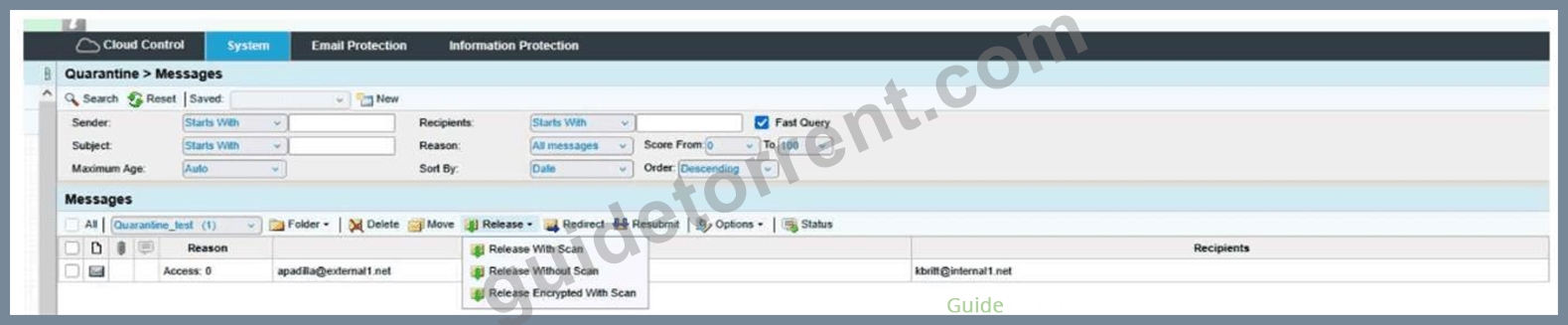
- A. Release the message to the user and deliver it encrypted.
- B. Resubmit the message to message defense and virus protection and release an encrypted message to the user.
- C. Resubmit the message to message defense and virus protection and release the message to the user.
- D. Encrypt the message and release the message to the user's digest.
Answer: B
Explanation:
The correct answer is D. Resubmit the message to message defense and virus protection and release an encrypted message to the user .
From the exhibit, the release menu shows three distinct actions:
* Release With Scan
* Release Without Scan
* Release Encrypted With Scan
The wording of Release Encrypted With Scan tells you two actions are happening together:
* The message is being rescanned through the relevant protection layers, which in the course context means it is resubmitted through Message Defense and Virus Protection .
* After that scan step, the message is released in encrypted form to the recipient.
That is why D is the only choice that includes both parts of the action: scan/resubmit and encrypted release .
Why the other options are incorrect:
* A is incomplete because it mentions encrypted delivery, but it leaves out the with scan portion.
* B is incomplete because it includes the rescan behavior, but it does not include encrypted delivery.
* C is incorrect because the action is not releasing the message to the user's digest; it is releasing the actual message to the user.
This is a Quarantine administration question focused on understanding the difference between release options. The exhibit clearly shows that Release Encrypted With Scan combines rescanning plus encrypted delivery , making Answer D the verified course-aligned choice.
NEW QUESTION # 48
You can drag the divider between the question and exhibit to the left to make the image larger.
Refer to the exhibit.
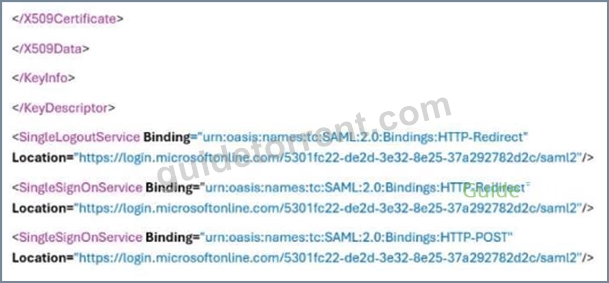
You are configuring SSO for Proofpoint Cloud Services, such as Cloud Admin, TAP Dashboard, Cloud Threat Response, CASB, and Identity Threat Response. The Microsoft O365 administrator sends you a portion of the XML file containing the SAML configuration. Which of the following strings should be entered in the "SAML Login Endpoint (required)" field in the Proofpoint Identity Provider Configuration?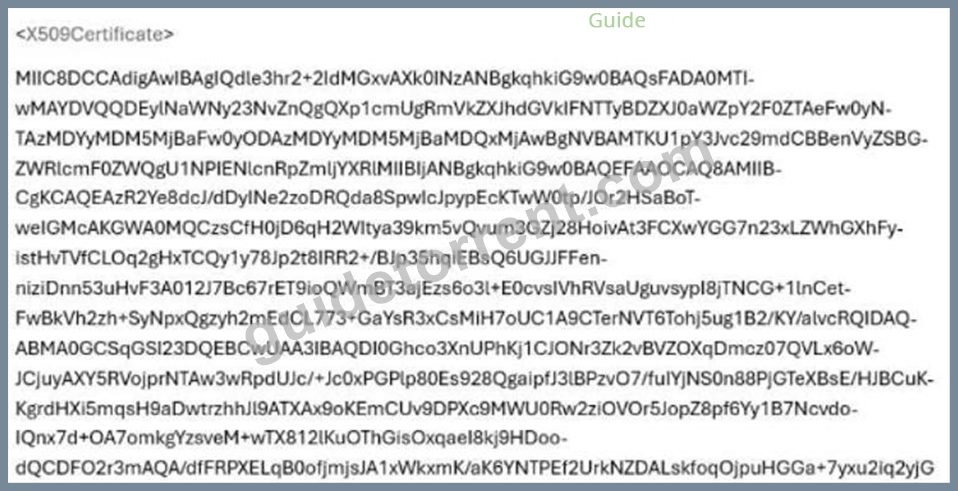
- A. https://enduserauth.proofpoint.com/v1/token/samlauthorization
- B. SingleSignOnService Binding="urn:oasis:names:tc:SAML:2.0:Binding:HTTP-Redirect"
- C. The data between < X509Certificate > and < /X509Certificate >
- D. https://login.microsoftonline.com/5301fc22-de2d-3e32-8e25-37a292782d2c/saml2
Answer: D
Explanation:
The correct answer is C. https://login.microsoftonline.com/5301fc22-de2d-3e32-8e25-37a292782d2c/saml2
.
The question is asking specifically for the value that should be entered in the "SAML Login Endpoint (required)" field in Proofpoint's Identity Provider configuration. In SAML metadata, that value is the Location attribute of the SingleSignOnService entry. In the exhibit, the XML clearly shows the Microsoft login URL as:
https://login.microsoftonline.com/5301fc22-de2d-3e32-8e25-37a292782d2c/saml2 That is the actual SAML login endpoint Proofpoint needs in order to redirect authentication requests to the Microsoft identity provider.
Why the other options are incorrect:
* A is the certificate content, which is used for trust and signature validation, not for the login endpoint.
* B is the XML element label and binding description, not the actual URL value that belongs in the field.
* D is a Proofpoint URL and not the Microsoft IdP SAML login endpoint shown in the metadata.
This is a User Management and federated-authentication question because it focuses on SSO configuration between Proofpoint Cloud Services and Microsoft O365 / Azure AD. The main concept being tested is knowing how to read SAML metadata correctly and extract the exact SingleSignOnService Location value.
So the complete interpretation of the exhibit is that the string to enter in the "SAML Login Endpoint (required)" field is the Microsoft SAML login URL shown in the XML, which makes Answer C the verified course-aligned choice.
NEW QUESTION # 49
Which Email Firewall features should be used together to mitigate directory harvest attacks?
- A. Recipient Verification
- B. Outbound Throttle
- C. Bounce Management
- D. Dictionaries
- E. SMTP Rate Control
Answer: A,E
Explanation:
Directory harvest attacks try to discover valid recipient addresses by sending large numbers of SMTP recipient attempts and observing which addresses are accepted or rejected. In Proofpoint's layered connection- level defenses, Recipient Verification and SMTP Rate Control are the two features that work together most directly against this problem. Recipient Verification checks whether the addressed mailbox is valid, while SMTP Rate Control helps detect and automatically block or throttle abusive SMTP connection behavior.
Proofpoint's published spam detection material describes connection-level analysis that includes recipient verification and Dynamic Reputation, and then states that based on this analysis, SMTP rate control is used to automatically block or throttle malicious connections, providing strong protection against directory harvest and denial-of-service attacks. That pairing is exactly what makes these two options the correct answer.
Outbound Throttle is aimed at controlling excessive outbound mail from accounts, not inbound recipient enumeration. Dictionaries are content and pattern controls, not recipient-existence validation controls. Bounce Management deals with BATV-style handling of backscatter, which is a different problem space. The Threat Protection Administrator course topic list also places SMTP Rate Control and Recipient Verification together under the same operational area, reinforcing that they are complementary controls for this class of attack. For a directory harvest scenario, these are the right two protections to deploy together.
NEW QUESTION # 50
In the mail route configuration shown, how does the Protection Server attempt delivery to example.com?
- A. It performs public MX lookup first and ignores the manually listed hosts
- B. It always uses the lowest entry first, then retries upward
- C. It tries to connect to the destination MTAs starting at the top and working down the list
- D. It randomizes the listed destination MTAs for load balancing
Answer: C
Explanation:
The correct answer is C. It tries to connect to the destination MTAs starting at the top and working down the list . This answer comes from the route-ordering behavior shown in the screenshot prompt and matches the way administrators are expected to interpret an ordered destination list in Proofpoint route configuration. In a manually defined route list, the order is meaningful, and the server attempts destinations according to that listed order rather than randomly.
This makes operational sense in Mail Flow administration. When administrators define multiple destination MTAs for a domain or route, they usually do so in a preferred sequence to control primary and fallback delivery behavior. Proofpoint's SMTP relay and MX references explain that mail delivery depends on how destination servers are selected and contacted, and ordered delivery logic is a standard part of controlled routing behavior.
The other options do not match the configured-route interpretation shown by the question. Randomization would defeat the purpose of explicitly ordered host entries. Starting from the bottom of the list is not the behavior indicated by the screen, and ignoring the configured hosts in favor of public MX lookup would undermine the value of manually defining a route in the first place. In the Threat Protection Administrator course, Mail Flow questions like this test whether the student understands that configured route order affects connection attempts. Therefore, the correct answer is C : the Protection Server starts at the top of the list and works downward .
NEW QUESTION # 51
You want an administrator, Peter Smith, to receive alerts when the SMTP Queue exceeds the configured threshold. How would you configure this?
Pick the 2 correct responses below.
- A. Enter the name of the correct Alert Profile into the SMTP Queue Threshold configuration box.
- B. Create an Alert Rule using the correct profile and subscribe it to the SMTP Queue above threshold alerts.
- C. Add Peter Smith's email address to a Policy Route and add that to the correct Alert Rule.
- D. Create an Alert Profile and add Peter Smith's email address to the recipient box.
- E. Create an Alert Rule and add in Peter Smith's email address to the SMTP Queue above threshold alerts.
Answer: B,D
Explanation:
The correct answers are A and D . Proofpoint's alert-notification model is based on two linked elements: a notification profile/policy that defines who receives alert emails, and an alert rule that determines which event triggers that notification. Proofpoint documentation states that notification policies define to whom and how often alert emails are sent, and that alert rules are associated with those notification policies. That maps directly to creating an alert profile with Peter Smith's email address in the recipient field, then creating or using the correct alert rule subscribed to the SMTP Queue above threshold alert.
The other options do not match how Proofpoint structures alert delivery. You do not simply place a profile name into a threshold box as the primary configuration mechanism, and you do not normally bypass the alert profile by inserting a recipient directly into the queue threshold item itself. Policy Routes are unrelated to alert-notification recipient management and are used for message-routing logic, not alert dispatch. In the Threat Protection Administrator course, the key concept is that alerts are generated by rules , but delivered to people through profiles . Therefore, to have Peter Smith receive SMTP Queue threshold alerts, you must create an alert profile that includes his address and bind that profile to an alert rule that subscribes to the SMTP Queue above threshold event. That makes A and D the verified answers.
NEW QUESTION # 52
What are the three default methods available in Recipient Verification to verify that a recipient mailbox exists?
Pick the 3 correct responses below.
- A. Email the recipient
- B. DNS verification
- C. CSV File verification
- D. SMTP verification
- E. User Repository verification
- F. LDAP verification
Answer: D,E,F
NEW QUESTION # 53
In a scenario where multiple members of a distribution group attempt to release the same quarantined email message from the scheduled digest, what will happen?
- A. The system allows all users to release the message, but logs the events for security audits
- B. All users will receive a notification that the message cannot be released due to a system error
- C. All members will successfully release the message without any errors
- D. The first user will release the message, while others will receive an error
Answer: D
NEW QUESTION # 54
The Abuse Mailbox event source was working in Cloud Threat Protection, but is now showing red under status and is no longer processing emails. After editing the source and clicking "Validate Source," you receive the error "Unable to validate mailbox." What is the likely cause of this error?
- A. There are no match conditions in workflows configured.
- B. The email server that hosts the abuse mailbox is disconnected.
- C. Alert linking has been disabled.
- D. Incorrect email address format.
Answer: B
Explanation:
The correct answer is A. The email server that hosts the abuse mailbox is disconnected . In Proofpoint's abuse-mailbox workflows, the mailbox must be reachable and functional for validation and ongoing message processing to succeed. Proofpoint's abuse-mailbox material emphasizes that abuse-mailbox handling depends on the mailbox receiving and processing reported messages as part of the investigation and remediation pipeline. If the mailbox or the mail system behind it becomes unavailable, validation failure is the most likely operational outcome.
The wording "Unable to validate mailbox" points to a connectivity or mailbox-access problem rather than a workflow-logic issue. Missing workflow match conditions would affect downstream automation behavior, but not the platform's ability to validate that the event source mailbox itself is reachable and usable. Likewise, disabling alert linking does not explain mailbox validation failure, and an incorrect email address format would more likely be caught as an obvious configuration input problem rather than as a mailbox validation failure after a source that was previously working suddenly turned red.
In the Threat Response course context, a source that was working and then becomes red strongly suggests an infrastructure or connectivity change. Since the event source depends on the hosted mailbox service continuing to accept and expose mail, the most likely cause is that the email server hosting the abuse mailbox is disconnected or unavailable . That makes A the course-aligned answer.
NEW QUESTION # 55
You have just been licensed to export the Smart Search data from your PoD protection server in JSON format.
Where would you create the API keys needed by your SIEM to ingest the JSON stream?
- A. The Threat Protection portal
- B. The web-based TAP Dashboard
- C. Admin UI on port 10000 of the PoD
- D. The web-based Admin Portal
Answer: C
Explanation:
The correct answer is A. Admin UI on port 10000 of the PoD . Proofpoint's hosted-cluster administration guidance notes that the accounts admin, and in hosted clusters the podadmin , can access the Admin GUI by direct login to port 10000 of the Proofpoint cluster. That direct administrative interface is the location associated with the underlying PoD administrative controls rather than the higher-level cloud portals used for threat investigation or dashboarding.
Additional integration guidance from Cortex XSOAR's Proofpoint Protection Server integration shows that API access for Proofpoint environments is tied to administrator roles with API permissions , and for on- premise or management-interface scenarios the API role is created in the management interface itself. That reinforces the course logic that SIEM-facing API credentials are created in the core administrative interface, not in TAP or general threat dashboards.
The other options are therefore incorrect in the course context. The TAP Dashboard is for targeted attack visibility and investigation, and the Threat Protection portal is used for operational threat workflows, not for creating the PoD-side API keys referenced in this question. Because the exam wording specifically mentions Smart Search data from your PoD protection server in JSON format , the administrative creation point is the direct PoD Admin UI on port 10000 . That is the option aligned with the product's administrative model and with the expected course answer.
NEW QUESTION # 56
Refer to the exhibit to see the interface used in this scenario.
Which of the following is true regarding the inbound mail route?
- A. You must have a minimum of five Destination MTAs when you use the Delivery Type of Ordered. This provides the minimum level of failover required by Proofpoint.
- B. When delivering mail to example.com the protection server tries to connect to the Destination MTAs starting at the top one and working down the list.
- C. When delivering mail to example.com the protection server tries to connect to the Destination MTAs starting at the bottom one and working up the list.
- D. You can only have multiple Destination hostname MTAs if you use the Delivery Type of Load Balanced. Ordered must specify the Destination MTAs as IP addresses.
Answer: B
Explanation:
The correct answer is D. When delivering mail to example.com the protection server tries to connect to the Destination MTAs starting at the top one and working down the list .
The exhibit shows that the inbound mail route for example.com is configured with three destination hosts:
* m1.example.com
* m2.example.com
* m3.example.com
It also shows that the Delivery Type is set to Ordered . In Proofpoint route configuration, Ordered means the system uses the listed destinations in sequence, following the order in which they appear in the route. That means the first connection attempt is made to the top entry , then if needed it proceeds downward through the remaining hosts.
Why the other choices are incorrect:
* A is incorrect because ordered delivery does not start from the bottom of the list.
* B is incorrect because multiple destination hostnames can be listed in an ordered route; they do not have to be IP addresses only.
* C is incorrect because there is no requirement shown here for a minimum of five MTAs for ordered delivery.
This is a Mail Flow question focused on route behavior. The main concept being tested is how Proofpoint uses the destination list when Ordered delivery is selected. The configured order matters, and the Protection Server follows that order from top to bottom .
So the complete interpretation of the exhibit is that the Protection Server attempts delivery starting with m1.
example.com , then m2.example.com , then m3.example.com , which makes Answer D the verified course- aligned choice.
NEW QUESTION # 57
......
TPAD01 Dumps - Pass Your Certification Exam: https://examcollection.guidetorrent.com/TPAD01-dumps-questions.html