
Ensure Success With Updated Verified CSC2 Exam Dumps [2025]
Exam Materials for You to Prepare & Pass CSC2 Exam.
NEW QUESTION # 105
The following table presents annual returns on TUV common stock and the S&P/TSX Composite Index over a three-year period.
What is TUV's beta relative to the S&P/TSX Composite Index over this three-year period?
- A. Exactly 1.
- B. Between 0 and 1.
- C. Less than 0.
- D. Greater than 1.
Answer: A
NEW QUESTION # 106
Which type of mutual funds tend to have the lowest management fees?
- A. Small cap
- B. Index
- C. Asset allocation
- D. Bond
Answer: B
Explanation:
Index mutual funds are structured to replicate the performance of a market index, such as the S&P/TSX Composite Index. Since these funds do not require active management, their management fees are among the lowest compared to other types of mutual funds. Active management in asset allocation, small-cap, or bond funds involves more frequent trading and research, increasing operational costs.
References:
* CSC Volume 2, Chapter 18: "Mutual Funds: Types and Features," discusses indexing as a fund management style and highlights its low costs compared to actively managed funds.
NEW QUESTION # 107
What industry stocks tend to have lower betas than the market?
- A. Capital goods
- B. Transportation
- C. Utilities
- D. Automobiles and components
Answer: C
Explanation:
Beta is a measure of a stock's volatility compared to the overall market. Stocks with lower betas tend to experience smaller price fluctuations relative to the market.
* Utilities:Utility companies generally have stable and predictable revenue streams because they provide essential services like electricity, water, and gas, which are always in demand regardless of economic cycles. As a result, utility stocks have lower betas, reflecting their lower sensitivity to market movements.
* Why Other Options Are Incorrect:
* A. Transportation: Stocks in this sector are more sensitive to economic changes and fuel prices, leading to higher betas.
* B. Capital Goods: This sector involves investments in industrial equipment and machinery, which fluctuate with economic cycles and have higher betas.
* D. Automobiles and Components: This industry is cyclical and highly dependent on economic trends, leading to higher betas.
References:
* CSC Volume 2, Chapter 13: Risk and return in specific industries.
NEW QUESTION # 108
What happens if a company's dividend payout ratio exceeds 100%?
- A. The company will be unable to repay its debts
- B. The share price will increase
- C. Shareholders' equity will be eroded
- D. Profits will be reduced
Answer: C
NEW QUESTION # 109
Siobhan designed an equity portfolio with a beta of 1.2. What is the expected return on the portfolio if the overall stock market return was 7.9%? (Round to the nearest decimal.)
- A. 9.5%
- B. 6.3%
- C. 6.6%
- D. 7.9%
Answer: A
NEW QUESTION # 110
What market condition is typically evident during the late contraction to end of contraction phases?
- A. Inverter yield curve.
- B. Interest rates fall
- C. Stock prices fall.
- D. Tight monetary policy
Answer: B
Explanation:
During the late contraction to the end of contraction phase in the business cycle, the economy typically begins to show early signs of recovery, leading to shifts in monetary policy and interest rate trends. This period is marked by declining interest rates. Here's a breakdown of the conditions evident in this phase:
* Economic Context:
* As the economy contracts, unemployment may still be relatively high, consumer and business confidence is weak, and production is below potential output. These conditions prompt monetary authorities to adopt accommodative policies.
* The central bank, such as the Bank of Canada, reduces interest rates to stimulate borrowing, investment, and spending, aiding in economic recovery.
* Interest Rate Dynamics:
* Falling interest rates are a hallmark of the late contraction phase. These declines occur as central banks aim to provide economic support and lower the cost of capital.
* Lower interest rates tend to support a recovery in equity markets and encourage investment activity, setting the stage for the next phase of growth.
* Yield Curve Observation:
* During this phase, the yield curve, which may have inverted during earlier contraction stages, starts to steepen. This steepening is indicative of improving economic expectations.
* Elimination of Tight Monetary Policies:
* Tight monetary policies, which involve high interest rates to curb inflation, are generally not present in this phase. Instead, monetary easing is observed.
References to Study Documents:
* Canadian Securities Course Volume 2, Chapter 13, "Fundamental and Technical Analysis," discusses the business cycle and its implications on market conditions.
* Volume 1, Chapter 4, "Overview of Economics," explains how interest rates influence the economy and describes their behavior during different phases of the business cycle.
NEW QUESTION # 111
What is a key characteristic of an actively managed product that might interest an investor?
- A. Assumes only systematic risk.
- B. Potential to outperform the market.
- C. Low fees.
- D. Access to money at any time.
Answer: B
NEW QUESTION # 112
For institutional trading, when does the investor need to provide trade-matching elements?
- A. One the custodian confirms the trade.
- B. Once the trade clears.
- C. After the dealer issues a trade execution notice.
- D. With the initial order.
Answer: C
Explanation:
Trade-matching is a critical process in institutional trading, ensuring that details of a trade (e.g., price, quantity, and settlement terms) align among the involved parties, including the investor, dealer, and custodian.
In Canada, institutional trade matching must occur within a specific timeline, and the investor is responsible for providing trade-matching elementsafter the trade execution notice is issued by the dealer.
Step-by-Step Explanation:
* What is Trade Matching?Trade matching involves the comparison of trade details between the buyer and seller (and their intermediaries) to confirm accuracy and reduce settlement risks.
* When Does the Investor Provide Trade-Matching Elements?
* After the dealer executes the trade, the dealer issues atrade execution noticeto the investor.
* The investor must then provide the necessary trade-matching details, such as account information, settlement instructions, and any other required confirmations.
* This process ensures that the trade can move seamlessly through to settlement.
* Why Not Other Options?
* Option B (Once the custodian confirms the trade):Incorrect. The custodian's role is typically involved in the final settlement process and not in providing trade-matching details.
* Option C (With the initial order):Incorrect. Trade-matching details are provided after the trade is executed, not at the time the order is placed.
* Option D (Once the trade clears):Incorrect. Trade matching occurs before the trade clears to ensure settlement.
References to Canadian Securities Course Exam 2 Study Materials:
* Volume 2, Chapter 27 - Institutional Clearing and Settlement
* Highlights the process of institutional trade matching, the roles of the investor, dealer, and custodian, and the required timelines.
* Volume 2, Chapter 27 - The Sell Side and the Buy Side of the Market
* Explains trade execution and the responsibilities of institutional clients and their intermediaries in completing trades.
Final answer:
* Option A (After the dealer issues a trade execution notice): Correct.
* Other options are incorrectbased on the standard processes for institutional trade matching in Canada.
NEW QUESTION # 113
Anwar is placing a market order to purchase 100 shares of AJL when the bid/ask is $10.25."$ 10.75. Before the trade is complete, the bid/ask moves to $10.207S1Q70. What is the share price that Anwar will pay on the purchase transaction?
- A. $10.29
- B. $10.20
- C. $10.75
- D. $10.70
Answer: D
Explanation:
A market order executes immediately at the best available ask price for a purchase transaction. In this case, the bid/ask initially was $10.25/$10.75. However, before execution, the ask price updated to $10.70, meaning Anwar will pay $10.70 per share.
* B. $10.75: This was the previous ask price but is no longer valid after the update.
* C. $10.29: This value is not relevant to the current bid/ask spread.
* D. $10.20: This represents the updated bid price, which applies to sell orders, not buy orders.
Reference:CSC Volume 1, Chapter 9, "How Securities are Bought and Sold - Types of Orders" explains market orders and their execution at the prevailing ask price.
NEW QUESTION # 114
According to the Bank of Canada, approximately how many months does it take for the effect of changes in monetary policy to be felt through the whole economy?
- A. 0
- B. 1
- C. 2
- D. 3
Answer: B
Explanation:
The Bank of Canada estimates that the effects of changes in monetary policy take approximately18 monthsto fully work through the entire economy. This lag exists because monetary policy impacts various sectors, such as consumer spending, business investment, and trade, at different speeds.
* B. 6 months: This is too short a timeframe for the full effects of monetary policy to materialize.
* C. 3 months: Immediate impacts may be seen in financial markets, but the broader economic effects require longer.
* D. 36 months: This is far longer than the typical lag for monetary policy effects.
NEW QUESTION # 115
The following information is available for REW Co:
What is the price of REW Co. if calculated using the dividend discount model?
- A. $13.75.
- B. $14.29.
- C. $12.50.
- D. $15.71.
Answer: B
NEW QUESTION # 116
The consumer price index was 125.9 in December of last year and 123.0 in December of the year before What was the inflation rate last year?
- A. 0.98%
- B. 2.30%
- C. 1.02%
- D. 2.36%
Answer: D
Explanation:
The inflation rate is calculated using the formula:
Inflation Rate=CPIcurrent#CPIpreviousCPIprevious×100\text{Inflation Rate} = \frac{\text{CPI}_{\text
{current}} - \text{CPI}_{\text{previous}}}{\text{CPI}_{\text{previous}}} \times
100Inflation Rate=CPIpreviousCPIcurrent#CPIprevious×100
Substitute the given values:
Inflation Rate=125.9#123.0123.0×100=2.9123.0×100#2.36%\text{Inflation Rate} = \frac{125.9 - 123.0}
{123.0} \times 100 = \frac{2.9}{123.0} \times 100 \approx 2.36\%Inflation Rate=123.0125.9#123.
0×100=123.02.9×100#2.36%
* B. 2.30%: This is close but results from rounding errors or miscalculation.
* C. 0.98% and D. 1.02%: These values are far below the correct inflation rate calculated using the formula.
Reference:CSC Volume 1, Chapter 4, "Measuring Inflation - Consumer Price Index" explains how to calculate inflation using CPI values.
NEW QUESTION # 117
What is typically a key tax attribute of dividends?
- A. Stock dividends are treated differently than regular cash dividends for tax purposes.
- B. Dividend income is taxed more preferentially than interest income.
- C. Reinvested dividends are non-taxable to the shareholders.
- D. Dividends from preferred shares are ineligible tot dividend tax credit.
Answer: B
Explanation:
Dividends are taxed at a preferential rate in Canada due to thedividend tax credit, which reduces the effective tax rate on dividend income. This is intended to prevent double taxation because corporations have already paid taxes on their profits before distributing dividends to shareholders.
* B. Dividends from preferred shares are ineligible for the dividend tax credit: This is incorrect; dividends from both common and preferred shares are eligible for the dividend tax credit.
* C. Stock dividends are treated differently than regular cash dividends for tax purposes: Stock dividends are generally taxed similarly to cash dividends.
* D. Reinvested dividends are non-taxable to the shareholders: Reinvested dividends are taxable in the year they are earned, even if reinvested.
NEW QUESTION # 118
Kenji is ready to place a large trade in a European small-cap ETF, traded on the TSX. It is 10 a.m. in Toronto, where Kenji is located. What trading tip can Kenji use to protect his trade from sudden price movements?
- A. Place his trade close to the end of the TSX's regular trading hours.
- B. Place his trade by executing it in small portions at a time.
- C. Place his trade when a trading halt is issued for any underlying ETF holding.
- D. Place his trade by using a limit order.
Answer: D
NEW QUESTION # 119
Which ratio gauges a company's ability to repay its debts using funds generated from operating activities?
- A. Interest coverage.
- B. Debt-to-equity
- C. Asset coverage.
- D. Cash flow-to-total debt
Answer: D
Explanation:
Thecash flow-to-total debt ratioassesses a company's ability to repay its debts using cash generated from its operating activities. It is calculated by dividing operating cash flow by total debt. A higher ratio indicates better capacity to cover debts. This metric is crucial for evaluating financial health and understanding a firm's liquidity position. Other ratios listed have different focuses:
* Interest coverage(B) measures a company's ability to pay interest with operating income.
* Asset coverage(C) measures the protection provided to creditors.
* Debt-to-equity(D) evaluates capital structure but not immediate debt repayment ability.
References
* CSC Volume 2, Chapter 14:Company Analysis - Risk Analysis Ratios, p. 14-12 to 14-16.
NEW QUESTION # 120
What type of risk were mortgage-backed securities designed to address?
- A. Rollover
- B. Interest rate
- C. Liquidity
- D. Prepayment
Answer: D
Explanation:
Mortgage-Backed Securities (MBS)are designed to addressprepayment risk, which arises when borrowers pay off their mortgages earlier than expected. Prepayments reduce the interest income investors receive and can affect the expected return on the security.
* Why Prepayment Risk is Addressed:
* Prepayment often occurs when interest rates decline, as borrowers refinance their mortgages. This leaves MBS investors reinvesting at lower yields, which impacts returns.
* Structuring MBS helps mitigate prepayment risk through mechanisms like tranches in Collateralized Mortgage Obligations (CMOs).
* Explanation of Options:
* A. Liquidity: Incorrect. MBS provides liquidity to lenders but is not designed to address liquidity risk directly.
* B. Interest Rate: Incorrect. MBS investors are still exposed to interest rate risk as rates impact prepayment behavior.
* C. Rollover: Incorrect. Rollover risk applies to short-term debt securities, not MBS.
* D. Prepayment: Correct. MBS structures are specifically designed to mitigate the impact of prepayments on investors.
References:
* CSC Volume 2, Chapter 23: Risks of structured products, particularly prepayment risks in MBS.
NEW QUESTION # 121
Which derivatives transaction has the greatest default risk?
- A. Individual investor buying shares on an exchange during the ex-rights period.
- B. Exchange-traded equity option contract between an individual investor and a dealer.
- C. Interest rate forward agreement between an investment dealer and a corporation.
- D. Individual investor entering future contract with an institutional investor.
Answer: C
Explanation:
An interest rate forward agreement (FRA) is an over-the-counter (OTC) derivative contract. Unlike exchange- traded derivatives, OTC contracts are not centrally cleared, meaning there is no intermediary to guarantee performance. This increases counterparty (default) risk, making FRAs inherently riskier than exchange-traded contracts.
* A. Individual investor buying shares on an exchange during the ex-rights period: This is a standard transaction involving equity securities, not derivatives, and carries no default risk.
* C. Exchange-traded equity option contract between an individual investor and a dealer: Exchange- traded derivatives are backed by a clearinghouse, which mitigates default risk.
* D. Individual investor entering a futures contract with an institutional investor: Futures contracts are also exchange-traded and centrally cleared, reducing default risk.
Reference:CSC Volume 1, Chapter 10, "The Role of Derivatives - Counterparty Risks in OTC Contracts" explains the higher default risk associated with OTC derivatives like FRAs.
NEW QUESTION # 122
What method of trading claims to offer greater liquidity and lower transaction costs?
- A. Algorithmic trading.
- B. High-frequency trading.
- C. Market timing.
- D. Dark pool.
Answer: B
NEW QUESTION # 123
What is the difference between sinking funds and purchase funds concerning the redemption of bonds poor to maturity?
- A. Sinking funds can redeem fie bones any time while purchase funds follow a prearranged schedule.
- B. Sinking funds involve the issuer determining when bonds are redeemed while purchase funds Involve the investor determining when the bonds are redeemed.
- C. Sinking funds can redeem bonds only if they trade below a stipulated price while purchase runes do not have such a requirement.
- D. Sinking funds have mandated redemptions while purchase funds can redeem only upon certain market conditions.
Answer: D
Explanation:
* Sinking funds require the issuer to redeem a specified portion of the bond issue at regular intervals. This ensures systematic debt reduction and is mandated regardless of market conditions.
* Purchase funds, however, allow the issuer to buy back bonds only if they are available in the market at or below a stipulated price, making redemption conditional on market conditions.
* B. Sinking funds can redeem bonds only if they trade below a stipulated price: This applies to purchase funds, not sinking funds.
* C. Sinking funds involve the issuer determining when bonds are redeemed while purchase funds involve the investor determining when the bonds are redeemed: Investors have no role in determining bond redemption under either method.
* D. Sinking funds can redeem the bonds any time while purchase funds follow a prearranged schedule:
Sinking funds follow a schedule, and purchase funds rely on market conditions.
Reference:CSC Volume 1, Chapter 6, "Bond Features - Sinking Funds and Purchase Funds" explains these mechanisms for bond redemption.
NEW QUESTION # 124
How is the ex-port real rate of return calculated?
- A. The ex-ante nominal rate of return minus the annual inflation rate.
- B. The ex-ante nominal rate of return adjusted by portfolio beta.
- C. The ex-post nominal rate of return minus the risk-free rate.
- D. The ex-post nominal rate of return minus the annual inflation rate.
Answer: D
Explanation:
Theex-post real rate of returnis a backward-looking measure calculated after the fact, using historical data.
It reflects the actual nominal rate of return adjusted for the actual rate of inflation over the same period. The formula is:
Ex-post real return=Nominal return#Inflation rate\text{Ex-post real return} = \text{Nominal return} - \text
{Inflation rate}Ex-post real return=Nominal return#Inflation rate
This measure helps assess the purchasing power of returns after accounting for inflation.
Other options are incorrect:
* A and Cdescribeex-antemeasures (forward-looking expectations).
* Bcalculates the nominal excess return above the risk-free rate, not the real return.
NEW QUESTION # 125
An advisor to explain the benefits of labour sponsored funds (LSVCC) to some of his clients.
With which client should the advisor have this discussion?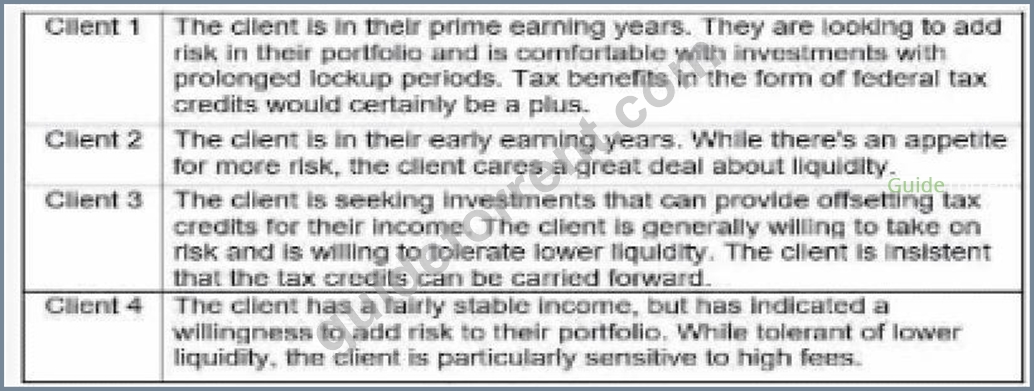
- A. Client 1
- B. Client 3
- C. Client 2
- D. Client 4
Answer: A
Explanation:
Labour Sponsored Venture Capital Corporations (LSVCCs), or labour-sponsored funds, are high-risk investments designed to stimulate job creation and economic growth. They provide tax benefits in the form of federal and, in some cases, provincial tax credits, making them attractive to investors in higher income brackets who are comfortable with the following:
* Increased portfolio risk
* Reduced liquidity due to long lockup periods
* High potential tax incentives
Analysis of Clients:
* Client 1:
* In their prime earning years and comfortable with higher risk and long lockup periods.
* Interested in tax benefits in the form of federal tax credits.
* Matches the profile of an ideal candidate for LSVCCs.
* Client 2:
* In early earning years and prioritizes liquidity over other factors.
* LSVCCs are unsuitable due to their lack of liquidity (e.g., lockup periods).
* Incorrect
* Client 3:
* Focused on investments with offsetting tax credits but insists on tax credits being carried forward.
* LSVCC tax credits cannot typically be carried forward, making them unsuitable.
* Incorrect
* Client 4:
* Stable income but sensitive to high fees.
* LSVCCs generally have high management fees, making them unsuitable.
* Incorrect
References to Canadian Securities Course Exam 2 Study Materials:
* Volume 2, Chapter 22 - Labour Sponsored Venture Capital Corporations
* Discusses LSVCCs, their tax advantages, high-risk nature, and reduced liquidity.
* Volume 2, Chapter 24 - Canadian Taxation
* Explains federal and provincial tax credits applicable to LSVCCs and their suitability for higher- income clients.
NEW QUESTION # 126
What might cause a company to have a high dividend payout rate?
- A. Stronger than expected earnings growth
- B. Unstable earnings that allow a high payout
- C. A company policy of buying back shares
- D. Earnings based on resources that are being depleted
Answer: D
NEW QUESTION # 127
John is a wealthy investor who frequently travels internationally. Why would a non-managed fee-based account be unsuitable for a client like John?
- A. Higher trading fees due to the one-on-one client-advisor relationship
- B. Clients must approve all trades
- C. Frequent meetings with the advisor are required
- D. Lack of customization to client needs
Answer: B
NEW QUESTION # 128
......
Updated CSC2 Certification Exam Sample Questions: https://examcollection.guidetorrent.com/CSC2-dumps-questions.html