
Practice Examples and Dumps & Tips for 2026 Latest JN0-336 Valid Tests Dumps
Latest [Mar 03, 2026] 100% Passing Guarantee - Brilliant JN0-336 Exam Questions PDF
NEW QUESTION # 47
Which two statements about SRX chassis clustering are correct? (Choose two.)
- A. SRX chassis clustering supports active/active for the control plane.
- B. SRX chassis clustering supports active/passive for the control plane.
- C. SRX chassis clustering supports active/passive and active/active for the data plane.
- D. SRX chassis clustering only supports active/passive for the data plane.
Answer: B,C
Explanation:
SRX chassis clustering allows for both active/passive and active/active configurations for the data plane.
In an active/passive setup, one node is active (handling traffic) while the other remains passive (idle and waiting to take over in case of failure). In an active/active setup, both nodes can handle traffic simultaneously, distributing different traffic flows or services between them for load balancing and redundancy.
For the control plane, SRX chassis clustering typically operates in an active/passive mode. This means one node actively handles the control plane responsibilities, such as managing routing tables and maintaining sessions, while the other stands by ready to take over these tasks if the active node fails.
NEW QUESTION # 48
Which two statements are correct about chassis clustering? (Choose two.)
- A. The node ID is used to identify each device in the chassis cluster.
- B. The cluster ID is used to identify each device in the chassis cluster.
- C. The node ID value ranges from 1 to 255.
- D. A system reboot is required to activate changes to the cluster.
Answer: A,D
Explanation:
In chassis clustering, the node ID is indeed used to uniquely identify each device within the cluster. This allows for individual addressing and management of devices within the cluster configuration, which is crucial for operations and maintenance.
Typically, activating changes that involve chassis clustering configuration, such as setting or changing the node ID or forming a new cluster, requires a reboot of the devices. This ensures that all configuration changes are properly applied and that the devices can synchronize their states as part of the cluster.
NEW QUESTION # 49
Click the Exhibit button.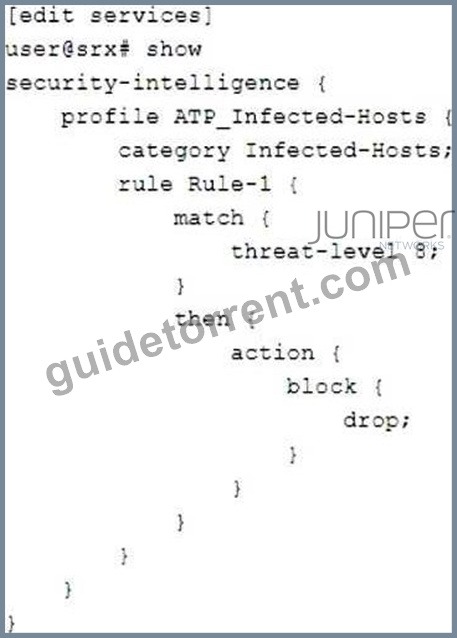
Referring to the exhibit, what will the SRX Series device do in this configuration?
- A. Packets from the infected hosts with a threat level of 8 will be dropped and no log message will be generated.
- B. Packets from the infected hosts with a threat level of 8 will be dropped and a log message will be generated.
- C. Packets from the infected hosts with a threat level of 8 or above will be dropped and a log message will be generated.
- D. Packets from the infected hosts with a threat level of 8 or above will be dropped and no log message will be generated.
Answer: D
Explanation:
The exhibit shows a configuration snippet for security intelligence on an SRX Series device. Security intelligence is a feature that allows you to block or monitor traffic from malicious sources based on threat intelligence feeds from Juniper ATP Cloud or other providers. The configuration defines a profile for ATP Infected-Hosts, which is a feed that contains IP addresses of hosts that are infected with malware and communicate with command-and-control servers. The configuration also defines a rule for threat level 8, which is a parameter that indicates the severity of the threat.
Based on this configuration, the SRX Series device will do the following:
Packets from the infected hosts with a threat level of 8 or above will be dropped: The action block-and- drop under the rule means that the device will block any traffic from the infected hosts that have a threat level equal to or higher than 8. This will prevent the hosts from sending or receiving malicious commands or data.
No log message will be generated: The absence of any log option under the rule means that the device will not generate any log message for the blocked traffic. This may reduce the load on the device and the logging server, but it may also limit the visibility and analysis of the security events. Reference: = Security Intelligence Theory, Firewall Filter Support on Loopback Interface
NEW QUESTION # 50
Exhibit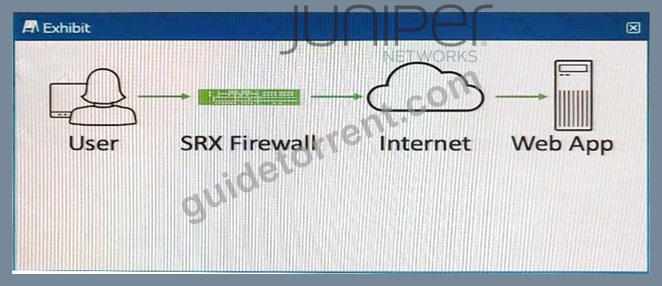
Referring to the exhibit, which two statements describe the type of proxy used? (Choose two.)
- A. forward proxy
- B. client protection proxy
- C. reverse proxy
- D. server protection proxy
Answer: A,C
Explanation:
In the exhibit, the SRX Firewall could be acting as a forward proxy, managing outbound internet requests from internal users or clients within a private network to the internet. Forward proxies are commonly used to control and monitor outbound traffic, provide content caching to improve load times, and enforce company policies.
The scenario can also imply a reverse proxy setup where the SRX Firewall might be configured to direct incoming requests from the internet to the web application. Reverse proxies are used to balance load, enhance security, manage SSL encryption, and provide additional caching functionalities for inbound traffic to servers.
NEW QUESTION # 51
You want to use IPS signatures to monitor traffic.
Which module in the AppSecure suite will help in this task?
- A. AppQoS
- B. AppFW
- C. APPID
- D. AppTrack
Answer: B
Explanation:
The AppFW module in the AppSecure suite provides IPS signatures that can be used to monitor traffic and detect malicious activities. AppFW also provides other security controls such as Web application firewall, URL filtering, and application-level visibility.
NEW QUESTION # 52
Which two statements are true about the fab interface in a chassis cluster? (Choose two.)
- A. The physical interface for the fab link must be specified in the configuration.
- B. The fab link does not support fragmentation.
- C. The fab link supports traditional interface features.
- D. The Junos OS supports only one fab link.
Answer: A,B
Explanation:
The fabric link, used for data traffic synchronization between cluster nodes, is designed to handle packets at full size. It does not support packet fragmentation, which means that packets should be sized appropriately to avoid issues related to packet size limitations on the fab interface.
For chassis clustering, the specific physical interfaces used as fabric links (fab links) must be explicitly defined in the configuration. This specification is crucial to ensure proper data flow between nodes for state synchronization and other clustering functions.
NEW QUESTION # 53
You set up the Juniper ATP Appliance solution on your network and notice that the macOS files are not being analyzed......... malware.
In this scenario, what must you do?
- A. Create a macOS virtual machine on the JATP Appliance and install the secondary core software.
- B. Under Config -> System Profiles→≥Secondary Cores workspace, create a macOS profile
- C. You must obtain a Apple Mac Mini device and install the secondary core software.
- D. Under Config > System Profiles≥Secondary Cores workspace, enable macOs Detection.
Answer: B
NEW QUESTION # 54
Your manager asks you to provide firewall and NAT services in a private cloud.
Which two solutions will fulfill the minimum requirements for this deployment? (Choose two.)
- A. a single vSRX
- B. a cSRX for firewall services and a separate cSRX for NAT services
- C. a vSRX for firewall services and a separate vSRX for NAT services
- D. a single cSRX
Answer: A,D
Explanation:
A single vSRX instance is capable of handling both firewall and NAT services simultaneously. This solution provides a streamlined and resource-efficient way to secure and manage network traffic within a private cloud environment.
Similar to the vSRX, a single cSRX can also provide both firewall and NAT services. The cSRX, being a containerized version of the SRX, is particularly suited for environments where high density and microservices architectures are used, offering high performance in a compact form factor.
NEW QUESTION # 55
You have deployed an SRX300 Series device and determined that files have stopped being scanned.
In this scenario, what is a reason for this problem?
- A. The software license is a free model and only scans executable type files.
- B. The file is too small to have a virus.
- C. The infected host communicated with a command-and-control server, but it did not download malware.
- D. You have exceeded the maximum files submission for your SRX platform size.
Answer: D
Explanation:
You have exceeded the maximum files submission for your SRX platform size: This statement is correct because file scanning on SRX300 Series device has a limit on the number of files that can be submitted per minute based on the platform size3. For example, SRX320 has a limit of 10 files per minute3.
NEW QUESTION # 56
Which statement defines the function of an Application Layer Gateway (ALG)?
- A. The ALG uses software processes for permitting or disallowing specific IP address ranges.
- B. The ALG contains protocols that use one application session for each TCP session.
- C. The ALG uses software processes for managing specific protocols.
- D. The ALG uses software that is used by a single TCP session using the same port numbers as the application.
Answer: C
Explanation:
The statement that defines the function of an Application Layer Gateway (ALG) is: The ALG uses software processes for managing specific protocols. An ALG is a security component that operates at the application layer (layer 7) of the OSI model and handles data associated with certain application protocols, such as SIP, FTP, RTSP, etc. An ALG acts as a proxy or intermediary between the client and the server applications and performs various functions, such as address and port translation, resource allocation, application response control, and synchronization of data and control traffic. An ALG can also inspect and modify the application payload to enable firewall or NAT traversal, prevent spoofing or DoS attacks, or enforce granular security policies based on application-specific commands. Reference: = Application-level gateway - Wikipedia, What Is an Application Layer Gateway (ALG)? | F5, What is ALG
** Application Layer Gateway | 3CX
NEW QUESTION # 57
You need to deploy an SRX Series device in your virtual environment. In this scenario, what are two benefits of using a CSRX? (Choose two.)
- A. The cSRX supports firewall, NAT, IPS, and UTM services.
- B. The cSRX supports Layer 2 and Layer 3 deployments.
- C. The cSRX default configuration contains three default zones: trust, untrust, and management.
- D. The cSRX has low memory requirements.
Answer: A,D
Explanation:
Two benefits of using a cSRX in your virtual environment are:
The cSRX supports firewall, NAT, IPS, and UTM services: The cSRX is a containerized version of the SRX Series firewall that runs as a Docker container on Linux hosts. It provides the same features and functionality as the SRX Series physical firewalls, such as firewall, NAT, IPS, and UTM services. The cSRX can protect your virtual workloads and applications from various threats and attacks.
The cSRX has low memory requirements: The cSRX is designed to be lightweight and efficient, with low memory and CPU requirements. The cSRX can run on as little as 1 GB of RAM and 1 vCPU, making it suitable for resource-constrained environments. Reference: = cSRX Overview, cSRX Container Firewall Datasheet
NEW QUESTION # 58
How does the SSL proxy detect if encryption is being used?
- A. It looks at the destination port number.
- B. It queries the client device.
- C. It uses application identity services.
- D. It verifies the length of the packet
Answer: A
Explanation:
The SSL proxy can detect if encryption is being used by looking at the destination port number of the packet. If the port number is 443, then the proxy can assume that the packet is being sent over an encrypted connection. If the port number is different, then the proxy can assume that the packet is not encrypted. For more information, please refer to the Juniper Networks JNCIS-SEC Study Guide.
NEW QUESTION # 59
Your network uses a single JSA host and you want to implement a cluster.
In this scenario, which two statements are correct? (Choose two.)
- A. The secondary host can backup multiple JSA primary hosts.
- B. The cluster virtual IP will need an unused IP address assigned.
- C. The software versions on both primary and secondary hosts
- D. The primary and secondary hosts must be configured with the same storage devices.
Answer: B,C
Explanation:
According to the Juniper Networks JNCIP-SEC Study Guide, when setting up a cluster with a single JSA host, both the primary and secondary hosts must have the same software version installed. Additionally, an unused IP address must be assigned to the cluster virtual IP. The primary and secondary hosts do not need to be configured with the same storage devices, and the secondary host cannot be used to backup multiple JSA primary hosts.
NEW QUESTION # 60
Which two statements about the DNS ALG are correct? (Choose two.)
- A. The DNS ALG supports VPN tunnels.
- B. The DNS ALG does not support NAT.
- C. The DNS ALG performs DNS doctoring.
- D. The DNS ALG supports DDNS.
Answer: A,C
Explanation:
The DNS Application Layer Gateway (ALG) is designed to manage and facilitate the successful passage of DNS traffic through a network device such as a firewall or NAT. Here are the correct statements regarding DNS ALG:
The DNS ALG performs DNS doctoring.
DNS doctoring is indeed a function of the DNS ALG where it modifies the payload of DNS responses to ensure that the information is aligned with the NAT policy. For example, it can rewrite the IP addresses in DNS responses to match the internal or external NAT'd IP address that the client should use.
The DNS ALG supports VPN tunnels.
DNS ALG can function across VPN tunnels by managing DNS traffic that traverses the tunnel, ensuring that the DNS queries and responses are correctly handled in environments where IP address translation occurs due to the VPN.
NEW QUESTION # 61
When a security policy is modified, which statement is correct about the default behavior for active sessions allowed by that policy?
- A. The active sessions allowed by the policy will be dropped.
- B. The active sessions allowed by the policy will continue unchanged.
- C. Only policy changes that involve modification of the application will cause the active sessions affected by the change to be dropped.
- D. Only policy changes that involve modification of the action field will cause the active sessions affected by the change to be dropped.
Answer: B
Explanation:
When you modify a security policy on the SRX Series device, the default behavior is that the existing sessions that match the policy will continue unchanged. This means that the policy modification will only affect new sessions that are initiated after the change. However, you can change this behavior by using the clear-policy-session command, which will clear all the sessions that match the modified policy and force them to re-evaluate the new policy. Reference: = JNCIS-SEC Certification, Open Learning - Security, Specialist (JNCIS-SEC), Security Policies (Advanced)
NEW QUESTION # 62
Which two statements are correct about JSA data collection? (Choose two.)
- A. The Event Collector parses logs
- B. The Flow Collector can use statistical sampling
- C. The Event Collector collects information using BGP FlowSpec.
- D. The Flow Collector parses logs.
Answer: A,B
Explanation:
The Flow Collector can use statistical sampling to collect and store network flow data in the JSA database. The Event Collector collects information from various sources including syslog, SNMP, NetFlow, and BGP FlowSpec. Both the Flow Collector and the Event Collector parse logs to extract useful information from the logs.
NEW QUESTION # 63
Which two functions does Juniper ATP Cloud perform to reduce delays in the inspection of files?
(Choose two.)
- A. Juniper ATP Cloud allows the creation of allowlists.
- B. Juniper ATP Cloud uses a single antivirus software package to analyze files.
- C. Juniper ATP Cloud performs a cache lookup on files.
- D. Juniper ATP Cloud allows end users to bypass the inspection of files.
Answer: A,C
Explanation:
Juniper ATP Cloud is a cloud-based service that provides advanced threat prevention and detection for your network. It integrates with SRX Series firewalls and MX Series routers to analyze files and network traffic for signs of malicious activity.
Two functions that Juniper ATP Cloud performs to reduce delays in the inspection of files are:
Juniper ATP Cloud allows the creation of allowlists: Allowlists are lists of trusted files or file hashes that are excluded from scanning by Juniper ATP Cloud. You can create allowlists based on file name, file type, file size, file hash, or sender domain. By using allowlists, you can reduce the number of files that need to be uploaded to Juniper ATP Cloud for analysis and improve the performance and efficiency of your network.
Juniper ATP Cloud performs a cache lookup on files: Cache lookup is a process that checks if a file has been previously scanned by Juniper ATP Cloud and if there is a cached verdict for it. If there is a cached verdict, Juniper ATP Cloud returns it immediately without scanning the file again. If there is no cached verdict, Juniper ATP Cloud uploads the file for analysis. By using cache lookup, you can reduce the time and bandwidth required for scanning files by Juniper ATP Cloud.
Reference: = [Juniper Advanced Threat Prevention Cloud (ATP Cloud)], [Configuring Allowlists],
[Understanding Cache Lookup]
NEW QUESTION # 64
......
JN0-336 are Available for Instant Access: https://examcollection.guidetorrent.com/JN0-336-dumps-questions.html