
Instant Download 300-620 Dumps Q&As Provide PDF&Test Engine
Fast Exam Updates 300-620 dumps with PDF Test Engine Practice
How to Prepare for Implementing Cisco Application Centric Infrastructure (300-620 DCACI)
Preparation Guide for Implementing Cisco Application Centric Infrastructure (300-620 DCACI)
Introduction for Implementing Cisco Application Centric Infrastructure (300-620 DCACI)
The Implementing Cisco Application Centric Infrastructure v1.0 (DCACI 300-620) exam is a 90-minute exam that is associated with the CCNP Data Center Certification and Cisco Certified Specialist - Data Center ACI Implementation certifications. This exam tests a candidate's knowledge of Cisco switches in ACI mode including configuration, implementation, and management. You will learn the essential skills, concepts, and technologies to be a contributing member of a cybersecurity operations center (SOC) including understanding the IT infrastructure, operations, and vulnerabilities.
Cisco ACI delivers an intent-based networking framework to enable agility in the data center. It captures higher-level business and user intent in the form of a policy and translates this intent into the network constructs necessary to dynamically provision the network, security, and infrastructure services. It uses a holistic systems-based approach, with tight integration between hardware and software and physical and virtual elements, an open ecosystem model, and innovative Cisco customer Application-Specific Integrated Circuits (ASICs) to enable unique business value for modern data centers. This unique approach uses a common policy-based operating model across the network, drastically reducing the cost and complexity of operating your network.
Before taking this exam, you should have the following knowledge and skills:
- ACI Packet Forwarding
- Integrations
- ACI Anywhere
- ACI Management
- External Network Connectivity
The following candidates can enroll for this exam:
- Server Administrators
- Storage Administrators
- Systems Engineers
- Network Engineers
- Network Administrators
- Cisco integrators and partners
To pass the Cisco 300-620 exam, candidates must have a solid understanding of networking fundamentals, as well as hands-on experience in designing, deploying, and troubleshooting ACI solutions. 300-620 exam consists of multiple-choice and simulation questions that test the candidate's ability to analyze complex scenarios and apply their knowledge to solve practical problems.
NEW QUESTION # 108
All workloads in VLAN 1001 have been migrated into EPG-1001. The requirement is to move the gateway address for VLAN 1001 from the core outside the Cisco ACI fabric into the Cisco ACI fabric. The endpoints in EPG-1001 must route traffic to endpoints in other EPGs and minimize flooded traffic in the fabric. Which configuration set is needed on the bridge domain to meet these requirements?
- A. Disable Local IP Learning Limit Disable Unicast Routing
- B. Enable Hardware Proxy Enable Unicast Routing
- C. Enable Flood
Enable Unicast Routing - D. Disable ARP Flood
Disable Limn Endpoint Learning
Answer: B
Explanation:
To move the gateway address for VLAN 1001 from the core outside the Cisco ACI fabric into the Cisco ACI fabric and ensure that endpoints in EPG-1001 route traffic to endpoints in other EPGs while minimizing flooded traffic in the fabric, the following configuration set is needed on the bridge domain:
Enable Hardware Proxy: This step involves enabling the hardware proxy feature, which allows the fabric to learn and maintain endpoint information more efficiently7.
Enable Unicast Routing: This step involves enabling unicast routing within the bridge domain, which allows for the routing of traffic between different EPGs and minimizes flooded traffic
NEW QUESTION # 109
Refer to the exhibit.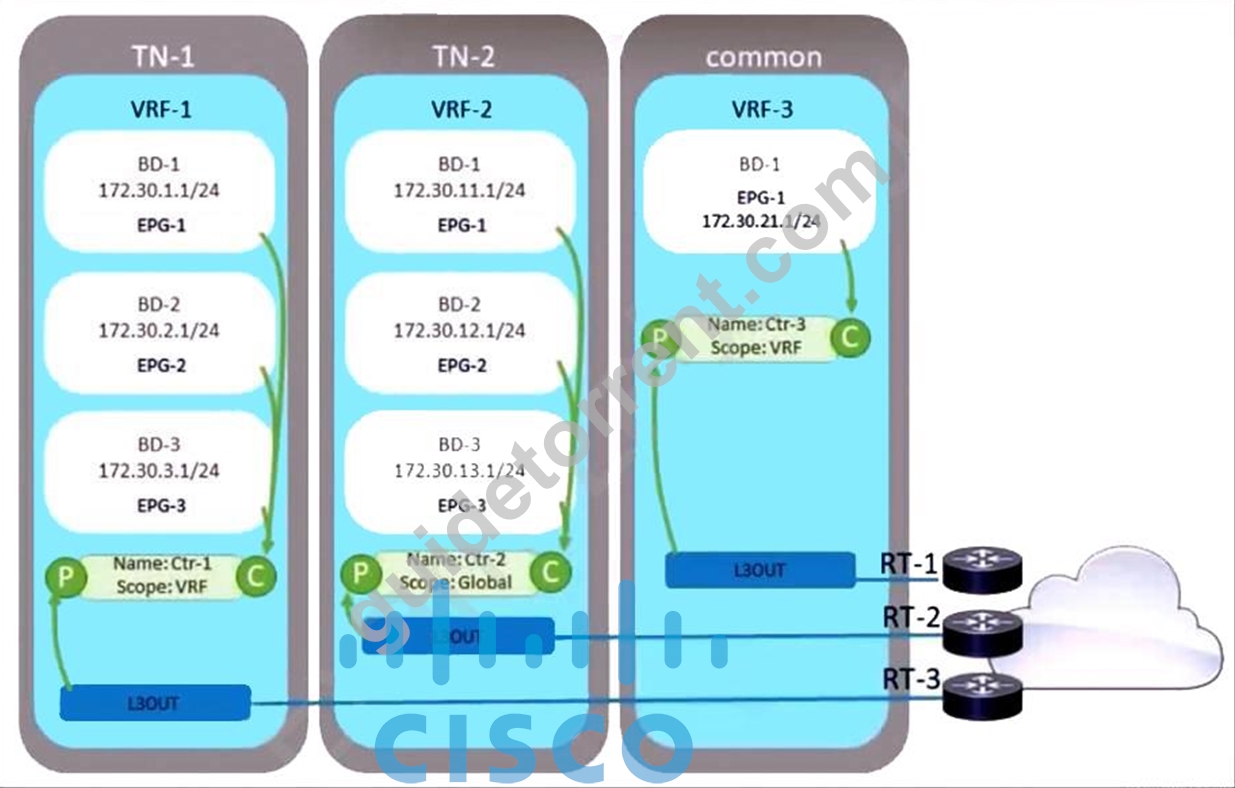
Refer to the exhibit. A company decided to decrease its routing footprint and remove RT-2 and RT-3 devices from its data center. Because of that, the exit point must be created from all the tenants by using the common tenant. Which two configuration tasks must be completed to meet these requirements? (Choose two.)
- A. Move subnets from all the bridge domains to the EPG level and mark them with flag Shared between VRFs.
- B. Mark all subnets with flag Shared between VRFs and attach contract Ctr-3 as a provider to all the EPGs.
- C. Update the L3Out ExtEPG subnet in the common tenant with flag Shared Route Control Subnet and Aggregate Shared Routes.
- D. Change contract Ctr-3 scope to Global, consume it by all EPGs, and flag all subnets with flag Shared between VRFs.
- E. Export contract Ctr-2 into the tenant TN-1 and attach it as a consumer to all the EPGs in the tenant TN-1.
Answer: A,D
NEW QUESTION # 110
Refer to the exhibit.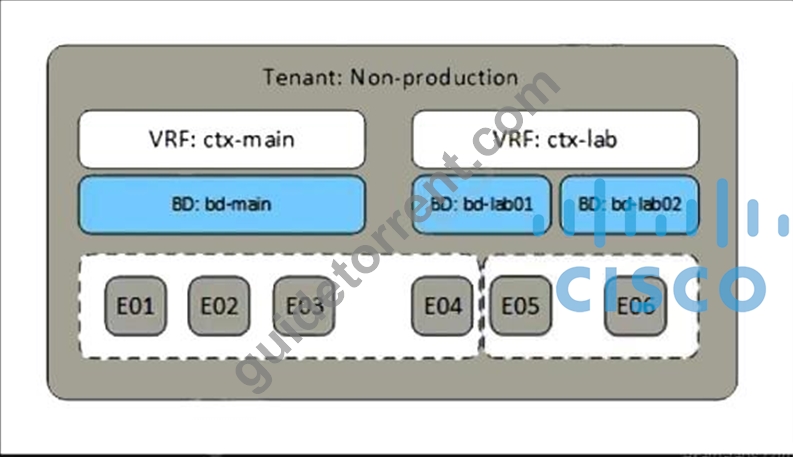
Refer to the exhibit. A network engineer must complete the Cisco ACI implementation based on the logical system design created by the systems architect. Which Cisco ACI object is required where the dotted line indicates to complete the task?
- A. contract
- B. context
- C. application profile
- D. attachable Access Entity Profile
Answer: A
Explanation:
In Cisco ACI, a contract is used to define the communication policy between EPGs (Endpoint Groups). It specifies which types of traffic are allowed to pass between EPGs and can include filters for protocols, ports, and other attributes. In the context of the logical system design, the contract would be the object that completes the communication requirements as indicated by the dotted line in the exhibit12.
Reference:
Cisco Application Centric Infrastructure (ACI) Design Guide1
Cisco ACI Policy Model Guide2
NEW QUESTION # 111
Refer to the exhibit.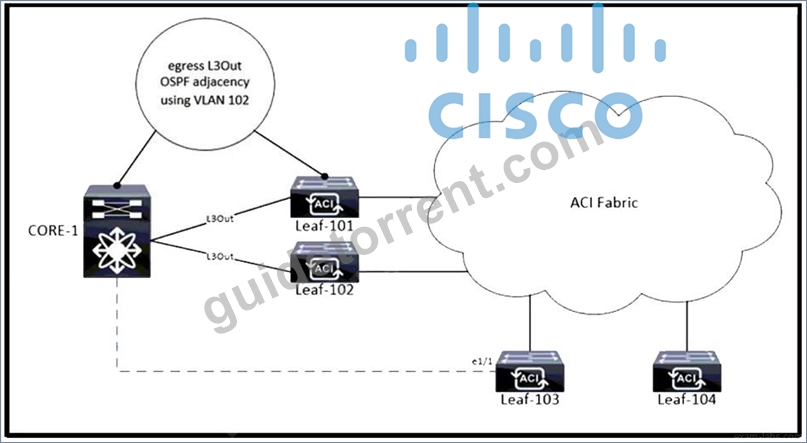
Refer to the exhibit. The Cisco ACI fabric has an egress L3Out from Leaf-101 and Leaf-102 to CORE-1. VLAN 102 is used to form the OSPF adjacency. The workloads must be migrated into EPG-101, and the static port binding is configured to Leaf-103 e1/1 with encap VLAN 101. An engineer completes the port binding and receives an MCP fault. Which action clears the fault?
- A. Use VLAN 101 for OSPF adjacency on the egress L3Out.
- B. Use VLAN 102 as the encap VLAN on the EPG-101 static port binding.
- C. Prune VLAN 101 from the VLAN pool that is used by the egress L3Out.
- D. Add VLAN 102 to the VLAN pool that is used by the static port binding.
Answer: B
NEW QUESTION # 112
An engineer is implementing a Cisco ACI environment that consists of more than 20 servers. Two of the servers support only Cisco Discovery Protocol with no order link discovery protocol. The engineer wants the servers to be discovered automatically by the Cisco ACI fabric when connected. Which action must be taken to meet this requirement?
- A. Configure a higher order interface policy that enables Cisco Discovery Protocol for the interface on the desired leaf switch.
- B. Configure a lower order policy group that enables Cisco Discovery Protocol for the interface on the desired leaf switch.
- C. Create an override policy that enables Cisco Discovery Protocol after LLDP is enabled in the default policy group.
- D. Create an interface profile for the interface that disables LLDP on the desired switch that is referenced by the interface policy group.
Answer: C
Explanation:
A leaf interface override policy allows interfaces that have interface policy group assignments to apply an alternate interface policy group.
Imagine that a group of ports have been configured on Node 101, using a specific interface policy group.
One of the interfaces connects to a firewall, and security policies dictate that LLDP and CDP toward the firewall need to be disabled on all firewall-facing interfaces.
It might be impossible to modify the interface policy group associated with the port because it might be part of a port block.
In this case, a leaf interface override can be used to assign an alternative interface policy group to the port of interest.
NEW QUESTION # 113
What is the minimum number of APICs does Cisco recommend to deploy in a production cluster?
- A. 0
- B. 1
- C. 2
- D. 3
Answer: A
Explanation:
The minimum number of APICs that Cisco recommends to deploy in a production cluster is 3 (Option B). This recommendation is based on the need for high availability and redundancy in a production environment.
NEW QUESTION # 114
Which endpoint learning operation is completed on the egress leaf switch when traffic is received from an L3Out?
- A. The source MAC address of the traffic is learned as a remote endpoint.
- B. No source MAC or IP address of the traffic is learned as a remote endpoint.
- C. The source MAC and IP address of the traffic is learned as a local endpoint.
- D. The source IP address of the traffic is learned as a remote endpoint.
Answer: B
Explanation:
On the egress leaf switch, when traffic is received from an L3Out, no source MAC or IP address of the traffic is learned as a remote endpoint1. The Cisco ACI fabric does not learn the IP addresses from the data plane in an L3Out domain; instead, it uses ARP to resolve next-hop IP and MAC relationships to reach the prefixes behind external routers1.
NEW QUESTION # 115
In the context of VMM, which protocol between ACI leaf and compute hosts ensures that the policies are pushed to the leaf switches for immediate and on demand resolution immediacy?
- A. VXLAN
- B. LLDP
- C. STP
- D. ISIS
Answer: B
Explanation:
Immediate-Specifies that EPG policies (including contracts and filters) are downloaded to the associated leaf switch software upon ESXi host attachment to a DVS. LLDP or OpFlex permissions are used to resolve the VM controller to leaf node attachments.
The policy will be downloaded to leaf when you add host to the VMM switch. CDP/LLDP neighborship from host to leaf is required.
On Demand-Specifies that a policy (for example, VLAN, VXLAN bindings, contracts, or filters) is pushed to the leaf node only when an ESXi host is attached to a DVS and a VM is placed in the port group (EPG).
The policy will be downloaded to leaf when host is added to VMM switch and virtual machine needs to be placed into port group (EPG). CDP/LLDP neighborship from host to leaf is required.
With both immediate and on demand, if host and leaf lose LLDP/CDP neighborship the policies are removed.
https://www.cisco.com/c/en/us/td/docs/switches/datacenter/aci/apic/sw/1-x/aci-fundamentals/b_ACI-Fundamentals/b_ACI-Fundamentals_chapter_01011.html
NEW QUESTION # 116
Which protocol does ACI use to securely sane the configuration in a remote location?
- A. TFTP
- B. HTTPS
- C. SCP
- D. FTP
Answer: C
Explanation:
Section: ACI Management
Explanation/Reference: https://www.cisco.com/c/en/us/td/docs/switches/datacenter/aci/apic/sw/kb/ b_KB_Using_Import_Export_to_Recover_Config_States.html
NEW QUESTION # 117
A Cisco APIC is configured to authenticate users by using RADIUS by default. The network administrator must ensure that the users can access the APIC GUI with a local account if the RADIUS server is unreachable. Which action achieves this goal?
- A. Configure the fallback login domain to reference Local Realm.
- B. Create an additional login domain to associate with local accounts.
- C. Set RADIUS Realm to connect with Console Authentication.
- D. Enable Fallback Check for Default Authentication.
Answer: B
NEW QUESTION # 118
An engineer associates EPG-A with a VMM domain and sets the Deployment and Resolution preferences to Immediate. The host that will generate endpoints for EPG-A is attached to Leaf-
101 and Leaf-102 using etht1/1. However, no configuration for EPG-A appears to have been pushed to the leaf switches. Which action must be taken for the configuration to be pushed to Leaf-101 and Leaf-102?
- A. Enable LACP on the leaf switch ports.
- B. Enable CDP or LLDP on the host.
- C. Disable and enable eth1/1 on both leaf switches.
- D. Configure both ports for trunking.
Answer: C
NEW QUESTION # 119
An engineer must allow multiple external networks to communicate with internal ACI subnets. Which action should the engineer take to assign the prefix to the class ID of the external Endpoint Group?
- A. Enable an L30ut with Shared Route Control Subnet.
- B. Enable the Export Route Control Subnet for the External Endpoint Group flag.
- C. Configure subnets with the Import Route Control Subnet flag enabled.
- D. Configure subnets with the External Subnets for External EPG flag enabled.
Answer: D
Explanation:
To allow multiple external networks to communicate with internal ACI subnets and assign the prefix to the class ID of the external Endpoint Group, the engineer should configure subnets with the External Subnets for External EPG flag enabled1. This configuration allows the specified subnets to be associated with an external EPG, which facilitates communication between internal tenants and external routed networks via L3Outs1.
https://www.cisco.com/c/en/us/td/docs/switches/datacenter/aci/apic/sw/1-x/ACI_Best_Practices/b_ACI_Best_Practices/b_ACI_Best_Practices_chapter_01001.html
NEW QUESTION # 120
When Layer 3 routed traffic is destined to a Cisco ACI fabric, which mechanism does ACI use to detect silent hosts?
- A. ARP gleaning
- B. proxy ARP
- C. inverse ARP
- D. gratuitous ARP
Answer: A
NEW QUESTION # 121
Refer to the exhibit. An engineer connects a Cisco ACI fabric to two different Cisco Nexus 9000 Series Switches. The fabric must be configured to ensure a loop-free topology and N9K1 must be configured as the root bridge for VLAN 10. Which action meets these requirements?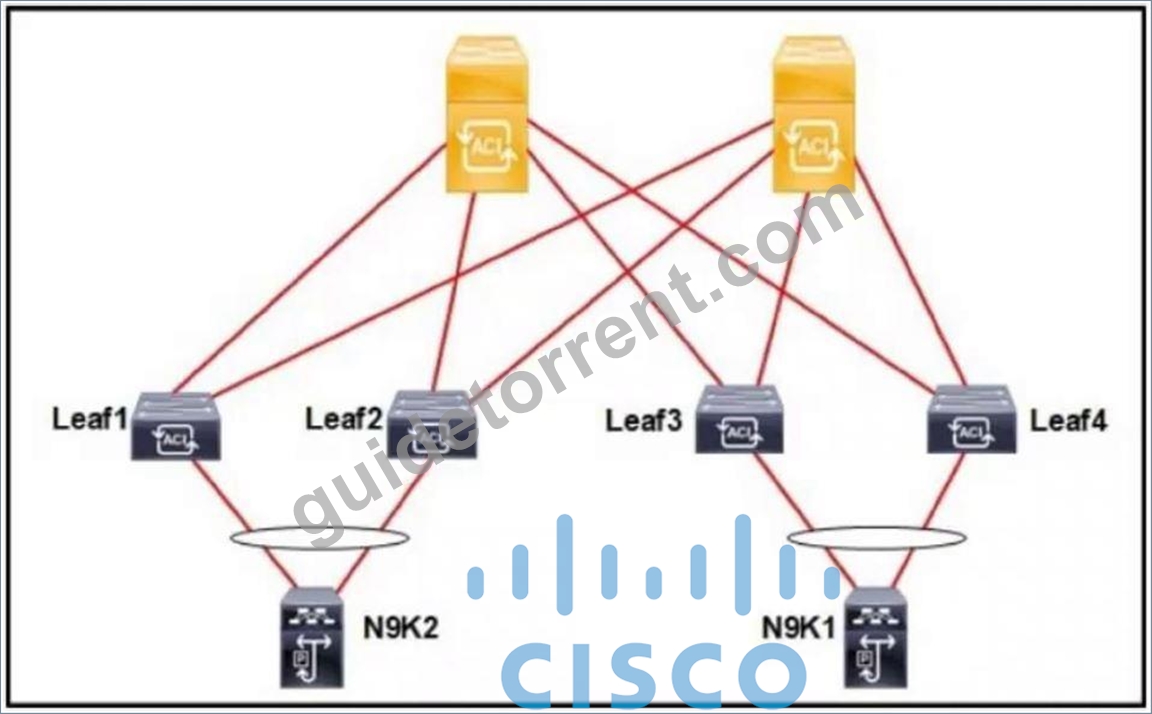
- A. Enable Cisco Discovery Protocol on ports between the leaf and spine.
- B. Set BPDU Guard on ports between the leaf and Nexus 9000 Series Switches.
- C. Activate MCP on ports between the leaf and Nexus 9000 Series Switches.
- D. Enable STP on ports between the leaf and spine.
Answer: C
NEW QUESTION # 122
A Cisco ACI environment consists of multiple silent hosts that are often relocated between leaf switches. When the host is relocated, the bridge domain takes more than a few seconds to relearn the host's new location. The requirement is to minimize the relocation impact and make the ACI fabric relearn the new location of the host faster. Which action must be taken to meet these requirements?
- A. Configure ARP Flooding to Enabled.
- B. Set Unicast Routing to Enabled.
- C. Set L2 Unknown Unicast to Hardware Proxy.
- D. Configure IP Data-Plane Learning to No.
Answer: D
Explanation:
In a Cisco ACI environment with multiple silent hosts that are often relocated between leaf switches, configuring IP Data-Plane Learning to 'No' will minimize the relocation impact and make the ACI fabric relearn the new location of the host faster. Disabling IP Data-Plane Learning prevents the fabric from learning IP addresses from the data plane, which can speed up the process of relearning host locations when they move3.
NEW QUESTION # 123
Which attribute should be configured for each user to enable RADIUS for external authentication in Cisco ACI?
- A. cisco-security domain
- B. cisco-av-pair
- C. cisco-aci-role
- D. cisco-auth-features
Answer: B
NEW QUESTION # 124
Which two statements regarding ACI Multi-Site are true? (Choose two.)
- A. ACI Multi-Site is a solution that supports a dedicated APIC cluster per site.
- B. The Inter-Site network routers should run OSPF to establish peering with the spines.
- C. ACI Multi-Site is a solution that allows one APIC cluster to manage multiple ACI sites.
- D. Routers in the Inter-Site network must run OSPF, DHCP relay, and MP-BGP.
- E. The Multi-Site orchestrator must be directly attached to one ACI leaf.
Answer: B,E
Explanation:
Section: ACI Anywhere
NEW QUESTION # 125
Which requirement must be met for the inter-pod network when connecting a remote leaf to a Cisco Application Centric Infrastructure fabric?
- A. multicast bidirectional PIM support
- B. border gateway protocol underlay for VTEP reachability
- C. less than 150ms end-to-end latency
- D. dynamic host configuration protocol relay configuration on the upstream router
Answer: D
Explanation:
When you extend a Cisco ACI fabric via a remote-leaf deployment, the remote leaves rely on an out-of-band DHCP service to get their management and tenant addresses. Because the remote- leaf switches don't host a local DHCP server, you must configure DHCP relay on the upstream (IPN) routers so that DHCP requests from the leaves are properly forwarded to your DHCP servers.
NEW QUESTION # 126
A network engineer must allow secure access to the Cisco ACl out-of-band (OOB) management only from external subnets 10 0 0024 and 192.168 20 G'25. Which configuration set accomplishes this goal?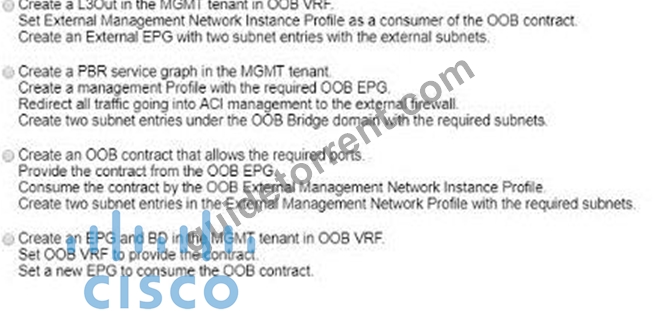
- A. Option A
- B. Option D
- C. Option B
- D. Option C
Answer: D
NEW QUESTION # 127
An engineer must connect Cisco ACI fabric using Layer 2 with external third-party switches. The third-party switches are configured using 802.1s protocol. Which two constructs are required to complete the task?
(Choose two.)
- A. MCP instance policy with administrative slate disabled
- B. spanning tree policy for mapping MST Instances to VLANs
- C. MCP policy with PDU per VLAN enabled
- D. static binding of native VLAN in all existing EPGs
- E. dedicated EPG for native VLAN
Answer: A,C
NEW QUESTION # 128
An engineer created two interface protocol policies called Pol_CDP40275332 and Pol_LLDP46783451. The policies must be used together in a single policy. Which ACI object must be used?
- A. interface policy group
- B. switch profile
- C. switch policy group
- D. interface profile
Answer: A
Explanation:
When two interface protocol policies need to be used together in a single policy, the ACI object that must be used is an interface policy group
NEW QUESTION # 129
An engineer configured Layer 2 extension from the ACI fabric and changed the Layer 2 unknown unicast policy from Flood to Hardware Proxy. How does this change affect the flooding of the L2 unknown unicast traffic?
- A. It is forwarded to one of the spines to perform as a spine proxy.
- B. It is flooded within the whole fabric.
- C. It is forwarded to one of the APICs to perform as a proxy.
- D. It is dropped by the leaf when the destination endpoint is not present in the endpoint table.
Answer: A
Explanation:
Reference:
https://www.cisco.com/c/en/us/td/docs/switches/datacenter/aci/apic/sw/2-x/L2_config/ b_Cisco_APIC_Layer_2_Configuration_Guide/ b_Cisco_APIC_Layer_2_Configuration_Guide_chapter_010.html
NEW QUESTION # 130
An engineer created two interface protocol policies called Pol_CDP40275332 and Pol_LLDP46783451. The policies must be used together in a single policy. Which ACI object must be used?
- A. interface policy group
- B. switch profile
- C. switch policy group
- D. interface profile
Answer: A
NEW QUESTION # 131
Which network protocol is used for Cisco ACI fabric data plane forwarding?
- A. VXLAN
- B. MP-BGP
- C. ISIS
- D. FabricPath
Answer: A
NEW QUESTION # 132
......
The Implementing Cisco Application Centric Infrastructure (300-620 DCACI) exam tests candidates on their ability to install, configure, and manage ACI environments using the latest Cisco technologies. 300-620 exam covers a wide range of topics, including ACI fabric infrastructure, ACI policies and automation, ACI network virtualization, and ACI external connectivity.
Exam Valid Dumps with Instant Download Free Updates: https://examcollection.guidetorrent.com/300-620-dumps-questions.html