
[Dec-2025] Study resources for the Valid SAA-C03 Braindumps!
Updated SAA-C03 Tests Engine pdf - All Free Dumps Guaranteed!
NEW QUESTION # 467
[Design Secure Architectures]
A development team needs to host a website that will be accessed by other teams. The website contents consist of HTML, CSS, client-side JavaScript, and images Which method is the MOST cost-effective for hosting the website?
- A. Deploy a web server on an Amazon EC2 instance to host the website.
- B. Containerize the website and host it in AWS Fargate.
- C. Create an Amazon S3 bucket and host the website there
- D. Configure an Application Loa d Balancer with an AWS Lambda target that uses the Express js framework.
Answer: C
Explanation:
In Static Websites, Web pages are returned by the server which are prebuilt.
They use simple languages such as HTML, CSS, or JavaScript.
There is no processing of content on the server (according to the user) in Static Websites. Web pages are returned by the server with no change therefore, static Websites are fast.
There is no interaction with databases.
Also, they are less costly as the host does not need to support server-side processing with different languages.
In Dynamic Websites, Web pages are returned by the server which are processed during runtime means they are not prebuilt web pages but they are built during runtime according to the user's demand.
These use server-side scripting languages such as PHP, Node.js, ASP.NET and many more supported by the server.
So, they are slower than static websites but updates and interaction with databases are possible.
NEW QUESTION # 468
A company runs an Oracle database on premises. As part of the company's migration to AWS, the company wants to upgrade the database to the most recent available version. The company also wants to set up disaster recovery (DR) for the database. The company needs to minimize the operational overhead for normal operations and DR setup. The company also needs to maintain access to the database's underlying operating system.
Which solution will meet these requirements?
- A. Migrate the Oracle database to Amazon RDS for Oracle. Activate Cross-Region automated backups to replicate the snapshots to another AWS Region.
- B. Migrate the Oracle database to Amazon RDS for Oracle. Create a standby database in another Availability Zone.
- C. Migrate the Oracle database to Amazon RDS Custom for Oracle. Create a read replica for the database in another AWS Region.
- D. Migrate the Oracle database to an Amazon EC2 instance. Set up database replication to a different AWS Region.
Answer: C
Explanation:
https://docs.aws.amazon.com/AmazonRDS/latest/UserGuide/rds-custom.html and
https://docs.aws.amazon.com/AmazonRDS/latest/UserGuide/working-with-custom-oracle.html
NEW QUESTION # 469
In a tech company that you are working for, there is a requirement to allow one IAM user to modify the configuration of one of your Elastic Load Balancers (ELB) which is used in a specific project. Each developer in your company has an individual IAM user and they usually move from one project to another.
Which of the following would be the best way to allow this access?
- A. Create a new IAM Role which will be assumed by the IAM user. Attach a policy allowing access to modify the ELB and once it is done, remove the IAM role from the user.
- B. Open up the port that ELB uses in a security group and then give the user access to that security group via a policy.
- C. Create a new IAM user that has access to modify the ELB. Delete that user when the work is completed.
- D. Provide the user temporary access to the root account for 8 hours only. Afterwards, change the password once the activity is completed.
Answer: A
Explanation:
In this scenario, the best option is to use IAM Role to provide access. You can create a new IAM Role then associate it to the IAM user. Attach a policy allowing access to modify the ELB and once it is done, remove the IAM role to the user.
An IAM role is similar to a user in that it is an AWS identity with permission policies that determine what the identity can and cannot do in AWS. However, instead of being uniquely associated with one person, a role is intended to be assumable by anyone who needs it. Also, a role does not have standard long- term credentials (password or access keys) associated with it. Instead, if a user assumes a role, temporary security credentials are created dynamically and provided to the user.
You can use roles to delegate access to users, applications, or services that don't normally have access to your AWS resources. For example, you might want to grant users in your AWS account access to resources they don't usually have, or grant users in one AWS account access to resources in another account. Or you might want to allow a mobile app to use AWS resources, but not want to embed AWS keys within the app (where they can be difficult to rotate and where users can potentially extract them).
Sometimes you want to give AWS access to users who already have identities defined outside of AWS, such as in your corporate directory. Or, you might want to grant access to your account to third parties so that they can perform an audit on your resources.
Explanation:
Reference:
https://docs.aws.amazon.com/IAM/latest/UserGuide/id_roles_create_for-user.html Check out this AWS IAM Cheat Sheet:
https://tutorialsdojo.com/aws-identity-and-access-management-iam/
NEW QUESTION # 470
A company is deploying a new application on Amazon EC2 instances. The application writes data to Amazon Elastic Block Store (Amazon EBS) volumes. The company needs to ensure that all data that is written to the EBS volumes is encrypted at rest.
Which solution will meet this requirement?
- A. Create the EBS volumes as encrypted volumes. Attach the EBS volumes to the EC2 instances
- B. Create an IAM role that specifies EBS encryption. Attach the role to the EC2 instances.
- C. Create an AWS Key Management Service (AWS KMS) key policy that enforces EBS encryption in the account. Ensure that the key policy is active
- D. Create an EC2 instance tag that has a key of Encrypt and a value of True. Tag all instances that require encryption at the EBS level.
Answer: A
Explanation:
The solution that will meet the requirement of ensuring that all data that is written to the EBS volumes is encrypted at rest is B. Create the EBS volumes as encrypted volumes and attach the encrypted EBS volumes to the EC2 instances. When you create an EBS volume, you can specify whether to encrypt the volume. If you choose to encrypt the volume, all data written to the volume is automatically encrypted at rest using AWS- managed keys. You can also use customer-managed keys (CMKs) stored in AWS KMS to encrypt and protect your EBS volumes. You can create encrypted EBS volumes and attach them to EC2 instances to ensure that all data written to the volumes is encrypted at rest.
NEW QUESTION # 471
A company hosts its application on several Amazon EC2 instances inside a VPC. The company creates a dedicated Amazon S3 bucket for each customer to store their relevant information in Amazon S3.
The company wants to ensure that the application running on EC2 instances can securely access only the S3 buckets that belong to the company's AWS account.
Which solution will meet these requirements with the LEAST operational overhead?
- A. Create a gateway endpoint for Amazon S3 that is attached to the VPC Update the 1AM instance profile policy to provide access to only the specific buckets that the application needs.
- B. Create a NAT Gateway in a public subnet Update route tables to use the NAT Gateway Assign bucket policies for all buckets with a Deny action and the following condition key:
- C. Create a gateway endpoint for Amazon S3 that is attached to the VPC Update the 1AM instance profile policy with a Deny action and the following condition key:
- D. Create a NAT gateway in a public subnet with a security group that allows access to only Amazon S3 Update the route tables to use the NAT Gateway.
Answer: A
NEW QUESTION # 472
A company has developed an API using Amazon API Gateway REST API and AWS Lambda. How can latency be reduced for users worldwide?
- A. Deploy the REST API as a Regional API endpoint. Enable caching. Enable content encoding to compress data in transit.
- B. Deploy the REST API as an edge-optimized API endpoint. Enable caching. Enable content encoding to compress data in transit.
- C. Deploy the REST API as an edge-optimized API endpoint. Enable caching. Configure reserved concurrency for Lambda functions.
- D. Deploy the REST API as a Regional API endpoint. Enable caching. Configure reserved concurrency for Lambda functions.
Answer: B
Explanation:
* Edge-optimized API endpoints route requests through CloudFront, reducing latency for global users.
* Option A correctly implements edge-optimization, caching, and compression to minimize latency.
* Options B and D do not use edge optimization, leading to higher latency for global users.
* Reserved concurrency in Options C and D improves backend scaling but does not address global latency directly.
NEW QUESTION # 473
A company wants to move its application to a serverless solution. The serverless solution needs to analyze existing and new data by using SL. The company stores the data in an Amazon S3 bucket. The data requires encryption and must be replicated to a different AWS Region.
Which solution will meet these requirements with the LEAST operational overhead?
- A. Create a new S3 bucket. Load the data into the new S3 bucket. Use S3 Cross-Region Replication (CRR) to replicate encrypted objects to an S3 bucket in another Region. Use server-side encryption with AWS KMS multi-Region kays (SSE-KMS). Use Amazon Athena to query the data.
- B. Load the data into the existing S3 bucket. Use S3 Cross-Region Replication (CRR) to replicate encrypted objects to an S3 bucket in another Region. Use server-side encryption with Amazon S3 managed encryption keys (SSE-S3). Use Amazon RDS to query the data.
- C. Load the data into the existing S3 bucket. Use S3 Cross-Region Replication (CRR) to replicate encrypted objects to an S3 bucket in another Region. Use server-side encryption with Amazon S3 managed encryption keys (SSE-S3). Use Amazon Athena to query the data.
- D. Create a new S3 bucket. Load the data into the new S3 bucket. Use S3 Cross-Region Replication (CRR) to replicate encrypted objects to an S3 bucket in another Region. Use server-side encryption with AWS KMS multi-Region keys (SSE-KMS). Use Amazon RDS to query the data.
Answer: A
Explanation:
This solution meets the requirements of a serverless solution, encryption, replication, and SQL analysis with the least operational overhead. Amazon Athena is a serverless interactive query service that can analyze data in S3 using standard SQL. S3 Cross-Region Replication (CRR) can replicate encrypted objects to an S3 bucket in another Region automatically. Server-side encryption with AWS KMS multi-Region keys (SSE- KMS) can encrypt the data at rest using keys that are replicated across multiple Regions. Creating a new S3 bucket can avoid potential conflicts with existing data or configurations.
Option B is incorrect because Amazon RDS is not a serverless solution and it cannot query data in S3 directly.
Option C is incorrect because server-side encryption with Amazon S3 managed encryption keys (SSE-S3) does not use KMS keys and it does not support multi-Region replication. Option D is incorrect because Amazon RDS is not a serverless solution and it cannot query data in S3 directly. It is also incorrect for the same reason as option C.
References:
* https://docs.aws.amazon.com/AmazonS3/latest/userguide/replication-walkthrough-4.html
* https://aws.amazon.com/blogs/storage/considering-four-different-replication-options-for-data-in- amazon-s3/
* https://docs.aws.amazon.com/AmazonS3/latest/userguide/UsingEncryption.html
* https://aws.amazon.com/athena/
NEW QUESTION # 474
[Design Secure Architectures]
An Amazon EC2 administrator created the following policy associated with an IAM group containing several users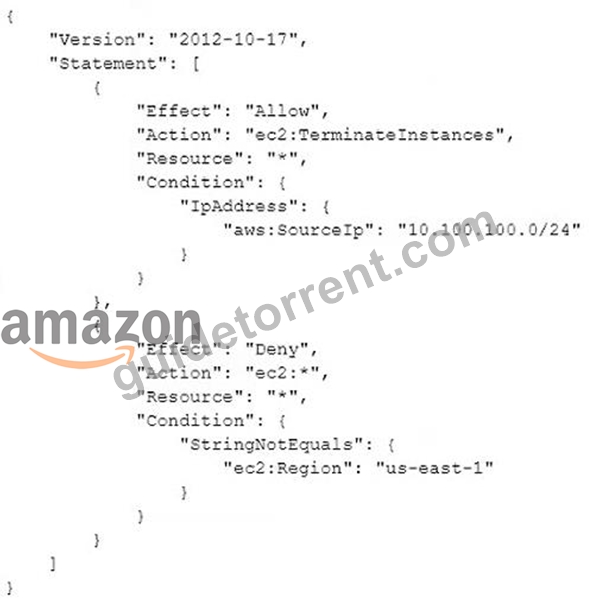
What is the effect of this policy?
- A. Users can terminate an EC2 instance in any AWS Region except us-east-1.
- B. Users cannot terminate an EC2 instance in the us-east-1 Region when the user's source IP is 10.100 100 254
- C. Users can terminate an EC2 instance in the us-east-1 Region when the user's source IP is 10.100.100.254.
- D. Users can terminate an EC2 instance with the IP address 10 100 100 1 in the us-east-1 Region
Answer: C
Explanation:
as the policy prevents anyone from doing any EC2 action on any region except us-east-1 and allows only users with source ip 10.100.100.0/24 to terminate instances. So user with source ip 10.100.100.254 can terminate instances in us-east-1 region.
NEW QUESTION # 475
A company wants to measure the effectiveness of its recent marketing campaigns. The company performs batch processing on csv files of sales data and stores the results an Amazon S3 bucket once every hour. The S3 bi petabytes of objects. The company runs one-time queries in Amazon Athena to determine which products are most popular on a particular date for a particular region Queries sometimes fail or take longer than expected to finish.
Which actions should a solutions architect take to improve the query performance and reliability? (Select TWO.)
- A. Reduce the S3 object sizes to less than 126 MB
- B. Use an AWS duo extract, transform, and load (ETL) process to convert the csv files into Apache Parquet format.
- C. Store the files as large, single objects in Amazon S3.
- D. Partition the data by date and region n Amazon S3
- E. Use Amazon Kinosis Data Analytics to run the Queries as pan of the batch processing operation
Answer: B,D
Explanation:
https://aws.amazon.com/blogs/big-data/top-10-performance-tuning-tips-for-amazon-athena/ This solution meets the requirements of measuring the effectiveness of marketing campaigns by performing batch processing on csv files of sales data and storing the results in an Amazon S3 bucket once every hour. An AWS duo ETL process can use services such as AWS Glue or AWS Data Pipeline to extract data from S3, transform it into a more efficient format such as Apache Parquet, and load it back into S3. Apache Parquet is a columnar storage format that can improve the query performance and reliability of Athena by reducing the amount of data scanned, improving compression ratio, and enabling predicate pushdown.
NEW QUESTION # 476
A company is subscribed to the AWS Business Support plan. Compliance rules require the company to check on AWS infrastructure health before deployments can proceed. The company needs a programmatic and automated way to check on infrastructure health at the beginning of new deployments.
Which solution will meet these requirements?
- A. Query the AWS Support API at the start of each deployment. Pause all new deployments if the API returns any open issues.
- B. Send an API call to each workload ahead of deployment. Pause the deployments if the API call fails.
- C. Use the AWS Health API at the start of each deployment. Pause all new deployments if the API returns any issues.
- D. Use the AWS Trusted Advisor API at the start of each deployment. Pause all new deployments if the API returns any issues.
Answer: C
Explanation:
The AWS Health API provides programmatic access to the AWS Health information that is presented in the AWS Personal Health Dashboard. You can use the API operations to get information about AWS Health events that affect your AWS services and resources. You can also use the API to enable or disable health-based insights for your organization. You can use the AWS Health API at the start of each deployment to check on AWS infrastructure health and pause all new deployments if the API returns any issues. Reference: https://docs.aws.amazon.com/health/latest/APIReference/Welcome.html
NEW QUESTION # 477
A company is hosting a web application on AWS using a single Amazon EC2 instance that stores user-uploaded documents in an Amazon EBS volume. For better scalability and availability, the company duplicated the architecture and created a second EC2 instance and EBS volume in another Availability Zone placing both behind an Application Load Balancer After completing this change, users reported that, each time they refreshed the website, they could see one subset of their documents or the other, but never all of the documents at the same time.
What should a solutions architect propose to ensure users see all of their documents at once?
- A. Copy the data from both EBS volumes to Amazon EFS Modify the application to save new documents to Amazon EFS
- B. Configure the Application Load Balancer to send the request to both servers Return each document from the correct server.
- C. Configure the Application Load Balancer to direct a user to the server with the documents
- D. Copy the data so both EBS volumes contain all the documents.
Answer: D
Explanation:
Amazon EFS provides file storage in the AWS Cloud. With Amazon EFS, you can create a file system, mount the file system on an Amazon EC2 instance, and then read and write data to and from your file system. You can mount an Amazon EFS file system in your VPC, through the Network File System versions 4.0 and
4.1 (NFSv4) protocol. We recommend using a current generation Linux NFSv4.1 client, such as those found in the latest Amazon Linux, Redhat, and Ubuntu AMIs, in conjunction with the Amazon EFS Mount Helper. For instructions, see Using the amazon-efs-utils Tools.
For a list of Amazon EC2 Linux Amazon Machine Images (AMIs) that support this protocol, see NFS Support. For some AMIs, you'll need to install an NFS client to mount your file system on your Amazon EC2 instance. For instructions, see Installing the NFS Client.
You can access your Amazon EFS file system concurrently from multiple NFS clients, so applications that scale beyond a single connection can access a file system. Amazon EC2 instances running in multiple Availability Zones within the same AWS Region can access the file system, so that many users can access and share a common data source.
https://docs.aws.amazon.com/efs/latest/ug/how-it-works.html#how-it-works-ec2
NEW QUESTION # 478
A company has a web application hosted over 10 Amazon EC2 instances with traffic directed by Amazon Route 53. The company occasionally experiences a timeout error when attempting to browse the application.
The networking team finds that some DNS queries return IP addresses of unhealthy instances, resulting in the timeout error.
What should a solutions architect implement to overcome these timeout errors?
- A. Create a Route 53 failover routing policy record for each EC2 instance. Associate a health check with each record.
- B. Create an Application Load Balancer (ALB) with a health check in front of the EC2 instances. Route to the ALB from Route 53.
- C. Create a Route 53 simple routing policy record for each EC2 instance. Associate a health check with each record.
- D. Create an Amazon CloudFront distribution with EC2 instances as its origin. Associate a health check with the EC2 instances.
Answer: B
Explanation:
Explanation
An Application Load Balancer (ALB) allows you to distribute incoming traffic across multiple backend instances, and can automatically route traffic to healthy instances while removing traffic from unhealthy instances. By using an ALB in front of the EC2 instances and routing traffic to it from Route 53, the load balancer can perform health checks on the instances and only route traffic to healthy instances, which should help to reduce or eliminate timeout errors caused by unhealthy instances.
NEW QUESTION # 479
A security team wants to limit access to specific services or actions in all of the team's AWS accounts. All accounts belong to a large organization in AWS Organizations. The solution must be scalable and there must be a single point where permissions can be maintained.
What should a solutions architect do to accomplish this?
- A. Create a security group to allow accounts and attach it to user groups.
- B. Create cross-account roles in each account to deny access to the services or actions.
- C. Create an ACL to provide access to the services or actions.
- D. Create a service control policy in the root organizational unit to deny access to the services or actions.
Answer: D
Explanation:
Service control policies (SCPs) are one type of policy that you can use to manage your organization. SCPs offer central control over the maximum available permissions for all accounts in your organization, allowing you to ensure your accounts stay within your organization's access control guidelines. See https://docs.aws.
amazon.com/organizations/latest/userguide/orgs_manage_policies_scp.html.
NEW QUESTION # 480
A company stores data in Amazon S3. According to regulations, the data must not contain personally identifiable information (PII). The company recently discovered that S3 buckets have some objects that contain PII. The company needs to automatically detect PII in S3 buckets and to notify the company's security team. Which solution will meet these requirements?
- A. Use Amazon Macie. Create an Amazon EventBridge rule to filter the SensitiveData event type from Macie findings and to send an Amazon Simple Notification Service (Amazon SNS) notification to the security team.
- B. Use Amazon Macie. Create an Amazon EventBridge rule to filter the SensitiveData:S3Object/Personal event type from Macie findings and to send an Amazon Simple Queue Service (Amazon SQS) notification to the security team.
- C. Use Amazon GuardDuty. Create an Amazon EventBridge rule to filter the CRITICAL event type from GuardDuty findings and to send an Amazon Simple Notification Service (Amazon SNS) notification to the security team.
- D. Use Amazon GuardDuty. Create an Amazon EventBridge rule to filter the CRITICAL event type from GuardDuty findings and to send an Amazon Simple Queue Service (Amazon SQS) notification to the security team.
Answer: A
Explanation:
Amazon Macie: Detects sensitive data such as PII in S3 buckets using machine learning.
* EventBridge Rule: Filters Macie findings for specific sensitive data events (e.g., SensitiveData).
* SNS Notification: Provides real-time alerts to the security team for immediate action.
: Amazon Macie Documentation, Amazon EventBridge Documentation
NEW QUESTION # 481
[Design Operationally Excellent Architectures]
A company uses an organization in AWS Organizations to manage AWS accounts that contain applications. The company sets up a dedicated monitoring member account in the organization. The company wants to query and visualize observability data across the accounts by using Amazon CloudWatch.
Which solution will meet these requirements?
- A. Create a new IAM user in the monitoring account. Create cross-account IAM policies in each AWS account. Attach the IAM policies to the new IAM user.
- B. Set up service control policies (SCPs) to provide access to CloudWatch in the monitoring account under the Organizations root organizational unit (OU).
- C. Enable CloudWatch cross-account observability for the monitoring account. Deploy an AWS CloudFormation template provided by the monitoring account in each AWS account to share the data with the monitoring account.
- D. Configure a new IAM user in the monitoring account. In each AWS account, configure an IAM policy to have access to query and visualize the CloudWatch data in the account. Attach the new IAM policy to the new IAM user.
Answer: C
Explanation:
This solution meets the requirements because it allows the monitoring account to query and visualize observability data across the accounts by using CloudWatch. CloudWatch cross-account observability is a feature that enables a central monitoring account to view and interact with observability data shared by other accounts. To enable cross-account observability, the monitoring account needs to configure the types of data to be shared (metrics, logs, and traces) and the source accounts to be linked. The source accounts can be specified by account IDs, organization IDs, or organization paths. To share the data with the monitoring account, the source accounts need to deploy an AWS CloudFormation template provided by the monitoring account. This template creates an observability link resource that represents the link between the source account and the monitoring account. The template also creates a sink resource that represents an attachment point in the monitoring account. The source accounts can share theirobservability data with the sink in the monitoring account. The monitoring account can then use the CloudWatch console, API, or CLI to search, analyze, and correlate the observability data across the accounts. Reference: CloudWatch cross-account observability, Setting up CloudWatch cross-account observability,
[Observability Access Manager API Reference]
NEW QUESTION # 482
......
SAA-C03 Dumps Updated Practice Test and 1187 unique questions: https://examcollection.guidetorrent.com/SAA-C03-dumps-questions.html