
[Dec-2025 Newly Released] JN0-683 Dumps for JNCIP-DC Certified
Updated Verified JN0-683 dumps Q&As - 100% Pass
NEW QUESTION # 25
Exhibit.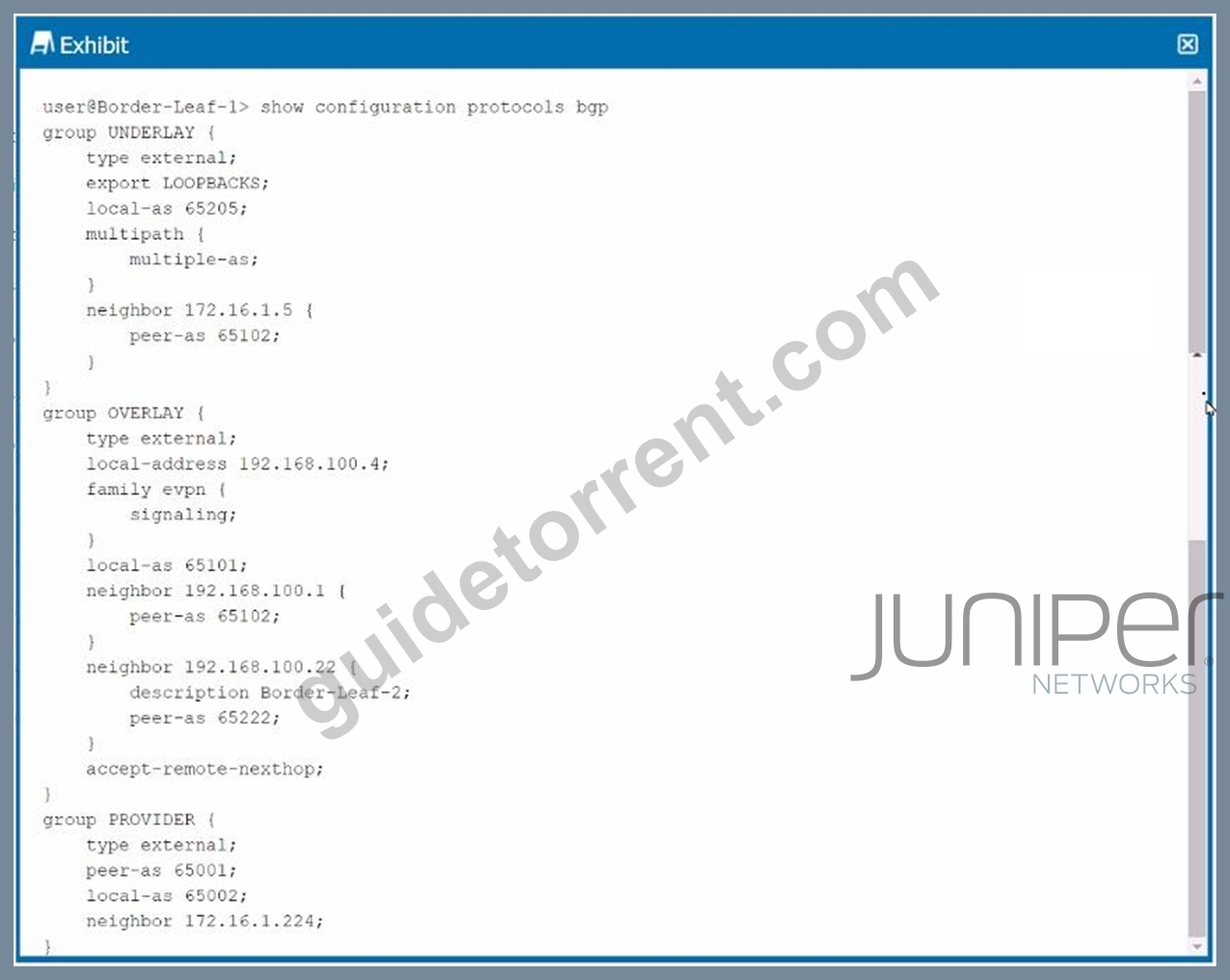
You are troubleshooting a DCI connection to another data center The BGP session to the provider is established, but the session to Border-Leaf-2 is not established. Referring to the exhibit, which configuration change should be made to solve the problem?
- A. set protocols bgp group PROVIDER export LOOPBACKS
- B. set protocols bgp group overlay export loopbacks
- C. delete protocols bgp group OVERLAY accept-remote-nexthop
- D. delete protocols bgp group UNDERLAY advertise-external
Answer: C
Explanation:
* Understanding the Configuration:
* The exhibit shows a BGP configuration on a Border-Leaf device. The BGP group UNDERLAY is used for the underlay network, OVERLAY for EVPN signaling, and PROVIDER for connecting to the provider network.
* The OVERLAY group has the accept-remote-nexthop statement, which is designed to accept the next-hop address learned from the remote peer as is, without modifying it.
* Problem Identification:
* The BGP session to Border-Leaf-2 is not established. A common issue in EVPN-VXLAN environments is related to next-hop reachability, especially when accept-remote-nexthop is configured.
* In typical EVPN-VXLAN setups, the next-hop address should be reachable within the overlay network. However, the accept-remote-nexthop can cause issues if the next-hop IP address is not directly reachable or conflicts with the expected behavior in the overlay.
* Corrective Action:
* D. delete protocols bgp group OVERLAY accept-remote-nexthop:Removing this command will ensure that the device uses its own IP address as the next-hop in BGP advertisements, which is standard practice in many EVPN-VXLAN setups. This change should help establish the BGP session with Border-Leaf-2.
Data Center References:
* Proper handling of BGP next-hop attributes is critical in establishing and maintaining stable BGP sessions, especially in complex multi-fabric environments like EVPN-VXLAN. Removing accept- remote-nexthop aligns with best practices in many scenarios.
NEW QUESTION # 26
You are asked to deploy 100 QFX Series devices using ZTP Each OFX5120 requires a different configuration. In this scenario, what are two components that you would configure on the DHCP server?
(Choose two.)
- A. the IP address of the FTP server
- B. the MAC address for each OFX5120
- C. the management IP address for each OFX5120
- D. the MAC address of the FTP server
Answer: B,C
Explanation:
* Zero Touch Provisioning (ZTP):
* ZTP allows for the automated configuration of network devices, like QFX Series switches, without manual intervention. During ZTP, a switch will obtain its configuration from a DHCP server and then download the required software and configuration files from a specified server (e.
g., FTP, HTTP).
* DHCP Server Configuration:
* Option B:The DHCP server needs to know theMAC address for each QFX5120to provide a specific configuration based on the device identity. By mapping the MAC address to a particular configuration, the DHCP server can ensure that each switch gets the correct configuration.
* Option D:Themanagement IP address for each QFX5120must also be assigned by the DHCP server. This IP address allows the device to communicate on the network and access the configuration files and other required resources during the ZTP process.
Conclusion:
* Option B:Correct-MAC addresses allow the DHCP server to identify each QFX5120 and assign the appropriate configuration.
* Option D:Correct-Management IP addresses are essential for network communication during ZTP.
NEW QUESTION # 27
Which two statements are correct about an IP fabric? (Choose two.)
- A. The multipath multiple-as statement is required to enable ECMP if every device has a different AS number.
- B. FBGP is only required to route mostrouting information to external devices outside the fabric.
- C. All leaf devices can use the same AS number in an IP fabric without making any adjustments to the EBGP configuration
- D. Only a single point to point EBGP session is required between peers in an IP fabric.
Answer: A,C
Explanation:
* BGP in IP Fabric:
* In an IP fabric, Border Gateway Protocol (BGP) is used to manage the routing between leaf and spine devices. Each device can have the same or different Autonomous System (AS) numbers depending on the network design.
* Multipath Multiple-AS:
* Option B:If every device in the fabric has a different AS number, then enabling Equal-Cost Multi-Path (ECMP) routing requires the multipath multiple-as statement. This configuration allows BGP to consider multiple paths across different AS numbers as equal cost, enabling efficient load balancing across the network.
* Same AS Number Configuration:
* Option A:It's possible for all leaf devices to use the same AS number in an IP fabric, which simplifies the configuration. EBGP (External BGP) will still function correctly in this setup because BGP considers the peering relationship rather than strictly enforcing different AS numbers in this specific use case.
Conclusion:
* Option B:Correct-This statement is essential for enabling ECMP in a multi-AS environment.
* Option A:Correct-Leaf devices can share the same AS number without needing special EBGP configuration.
NEW QUESTION # 28
You are asked to configure telemetry on the OFX Series devices in your data center fabric. You want to use sensors that have a vendor-neutral data model Which type of sensor should you use in this scenario?
- A. analog sensors
- B. JTI native sensors
- C. JTI OpenConfig sensors
- D. Python sensors
Answer: C
Explanation:
* Telemetry in Data Centers:
* Telemetry allows for real-time monitoring of network devices by collecting and exporting data such as interface statistics, routing table updates, and other key metrics.
* Vendor-Neutral Data Models:
* Option A:JTI (Junos Telemetry Interface) OpenConfig sensors use a vendor-neutral data model, which is important for ensuring compatibility across different network devices and systems.
OpenConfig is an industry-standard model, which facilitates integration with various telemetry collection systems.
Conclusion:
* Option A:Correct-OpenConfig sensors provide a vendor-neutral solution for telemetry, ensuring broad compatibility and flexibility in data center environments.
NEW QUESTION # 29
Click the Exhibit button.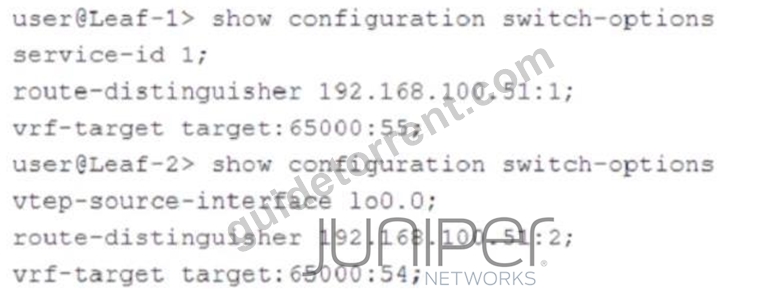
Connections between hosts connected to Leaf-1 and Leaf-2 are not working correctly.
Referring to the exhibit, which two configuration changes are required to solve the problem? (Choose two.)
- A. Configure the set switch-options vrf-target target:65000:55 parameter on Leaf-2.
- B. Configure the set switch-options route-distinguisher 192.168.100.51:2 parameter on Leaf-1.
- C. Configure the set switch-options service-id 1 parameter on Leaf-2.
- D. Configure the set switch-options vtep-source-interface lo0.0 parameter on Leaf-1.
Answer: A,D
NEW QUESTION # 30
You are deploying a new network lo support your Al workloads on devices that support at least 400 Gbps Ethernet. There is no requirement for any Layer 2 VLANs in this network. Which network architecture would satisfy this requirement?
- A. an IP fabric using the EVPN-MPLS architecture
- B. an IP fabric with an EVPN-VXLAN architecture
- C. an IP fabric using PIM-SM to signal VXLAN overlay
- D. an IP fabric using EBGP
Answer: D
Explanation:
* Requirements for AI Workloads:
* The scenario requires a network that supports at least 400 Gbps Ethernet and does not require Layer 2 VLANs. This setup is well-suited for a pure Layer 3 network, which can efficiently route traffic between devices without the overhead or complexity of maintaining Layer 2 domains.
* Choosing the Right Network Architecture:
* Option D:An IP fabric using EBGP (External BGP) is ideal for this scenario. In a typical IP fabric, EBGP is used to handle routing between spine and leaf switches, creating a scalable and efficient network. Since there is no need for Layer 2 VLANs, the pure IP fabric design with EBGP provides a straightforward and effective solution.
* Options A, B, and Cinvolve more complex architectures (like VXLAN or EVPN), which are unnecessary when there's no requirement for Layer 2 overlays or VLANs.
Conclusion:
* Option D:Correct-An IP fabric with EBGP is the most suitable and straightforward architecture for a network that needs to support high-speed AI workloads without Layer 2 VLANs.
NEW QUESTION # 31
You are implementing VXLAN broadcast domains in your data center environment. Which two statements are correct in this scenario? (Choose two.)
- A. The VNI is a 16-bit value and can range from 0 through 16.777.215.
- B. Layer 2 frames are encapsulated by the source VTEP.
- C. A VXLAN packet does not contain a VLAN ID.
- D. The VNI must match the VLAN tag to ensure that the remote VTEP can decapsulate VXLAN packets.
Answer: B,C
Explanation:
* VXLAN Overview:
* VXLAN (Virtual Extensible LAN) is a network virtualization technology that encapsulates Layer
2 Ethernet frames into Layer 3 UDP packets for transmission over an IP network. It allows the creation of Layer 2 overlay networks across a Layer 3 infrastructure.
* Understanding VXLAN Components:
* VTEP (VXLAN Tunnel Endpoint):A VTEP is responsible for encapsulating and decapsulating Ethernet frames into and from VXLAN packets.
* VNI (VXLAN Network Identifier):A 24-bit identifier used to distinguish different VXLAN segments, allowing for up to 16 million unique segments.
* Correct Statements:
* C. Layer 2 frames are encapsulated by the source VTEP:This is correct. In a VXLAN deployment, the source VTEP encapsulates the original Layer 2 Ethernet frame into a VXLAN packet before transmitting it over the IP network to the destination VTEP, which then decapsulates it.
* A. A VXLAN packet does not contain a VLAN ID:This is correct. The VXLAN header does not carry the original VLAN ID; instead, it uses the VNI to identify the network segment. The VLAN ID is local to the switch and does not traverse the VXLAN tunnel.
* Incorrect Statements:
* B. The VNI must match the VLAN tag to ensure that the remote VTEP can decapsulate VXLAN packets:This is incorrect. The VNI is independent of the VLAN tag, and the VLAN ID does not need to match the VNI. The VNI is what the remote VTEP uses to identify the correct VXLAN segment.
* D. The VNI is a 16-bit value and can range from 0 through 16,777,215:This is incorrect because the VNI is a 24-bit value, allowing for a range of 0 to 16,777,215.
Data Center References:
* VXLAN technology is critical for modern data centers as it enables scalability and efficient segmentation without the constraints of traditional VLAN limits.
NEW QUESTION # 32
Exhibit.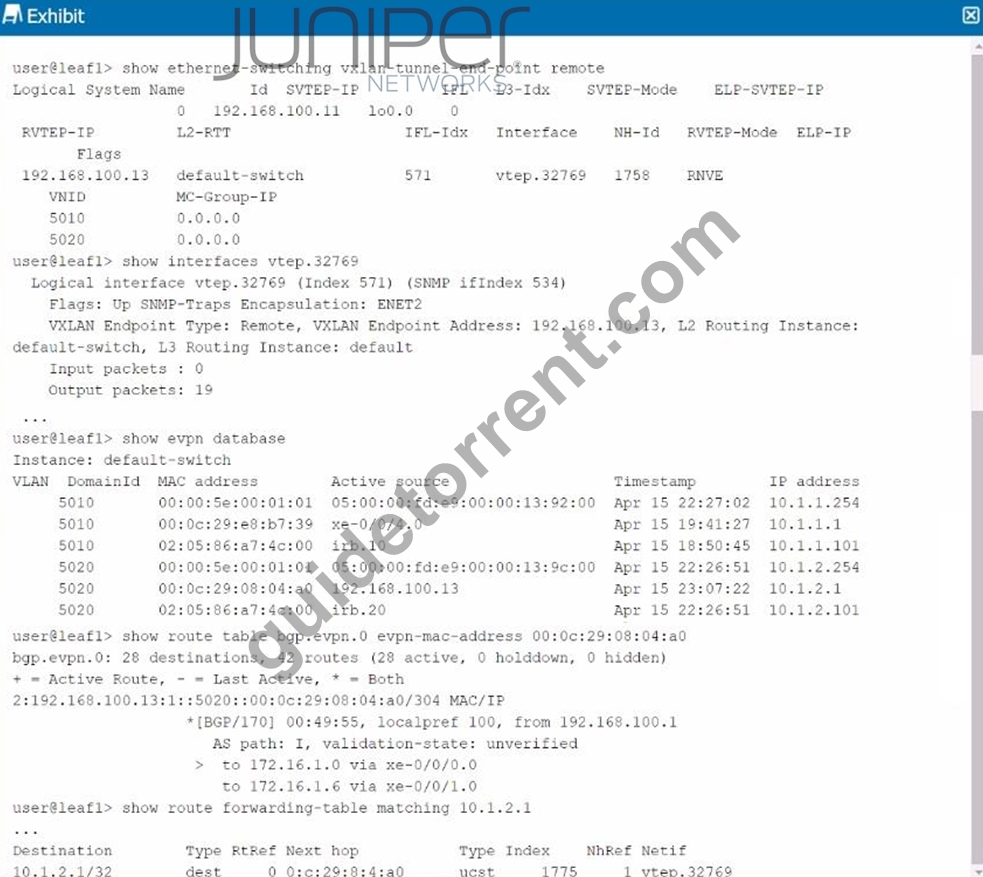
Referring to the exhibit, Host1 (10.1.1.1) is failing to communicate with Host2 (10.1.2.1) in a data center that uses an ERB architecture. What do you determine from the output?
- A. The traffic is failing because load balancing is not configured correctly.
- B. The irb.20 interface is not configured on leaf1.
- C. The traffic is entering the VXLAN tunnel.
- D. Host1 and Host2 are directly connected to leaf1.
Answer: C
Explanation:
Understanding the Problem:
* Host1 (10.1.1.1) is failing to communicate with Host2 (10.1.2.1) within an EVPN-VXLAN environment using ERB architecture.
Analysis of the Exhibit:
* The provided output includes information from the show route forwarding-table matching command for IP 10.1.2.1. The next hop is shown as vtep.32769, which indicates that the traffic destined for 10.1.2.1 is being forwarded into the VXLAN tunnel with the correct VTEP (VXLAN Tunnel Endpoint).
Conclusion:
* Option B:Correct-The traffic from Host1 is entering the VXLAN tunnel, as evidenced by the next hop pointing to a VTEP. However, the issue could lie elsewhere, possibly with the remote VTEP, routing configurations, or the receiving leaf/spine devices.
NEW QUESTION # 33
Exhibit.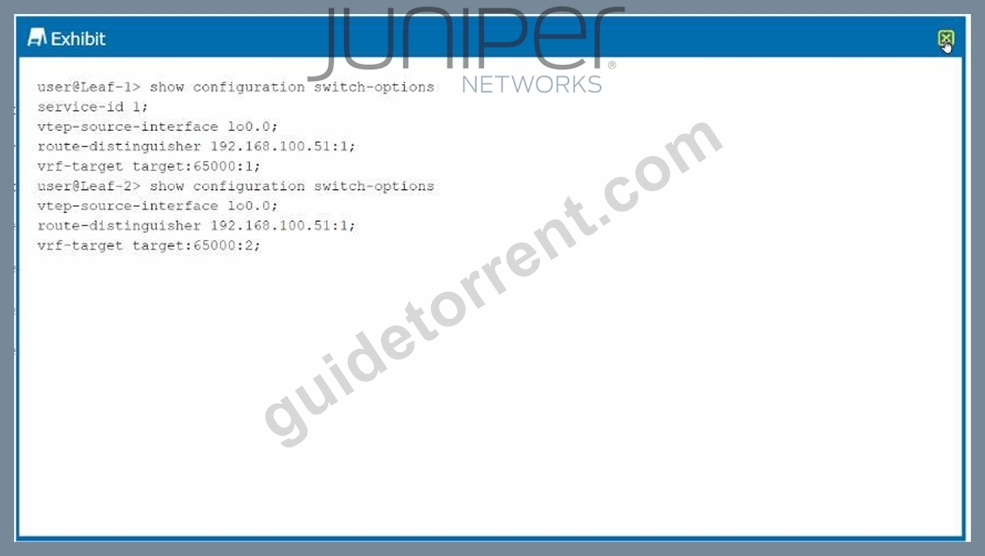
Connections between hosts connected to Leaf-1 and Leaf-2 are not working correctly.
- A. Referring to the exhibit, which two configuration changes are required to solve the problem? (Choose two.)
- B. Configure the set switch-options service-id 1 parameter on Leaf-2.
- C. Configure the set switch-options vtep-source-interface irb.0 parameter on Leaf-1.
- D. Configure the set switch-options route-distinguisher i92.168.100.50:1parameter on Leaf-1.
- E. Configure the set switch-options vrf-target target:65000:1parameteron Leaf-2.
Answer: D,E
NEW QUESTION # 34
Why is a designated forwarder required in a multihomed CE-to-PE VXLAN environmentusing EVPN signalling?
- A. The designated forwarder is required to prevent packets from looping between the PEs.
- B. The designated forwarder is required to prevent duplicate packets from being received on multihomed hosts.
- C. The designated forwarder is required to prevent a traffic storm from being received on multihomed hosts.
- D. The designated forwarder is required to prevent flooding of MAC addresses to multihomed hosts.
Answer: B
Explanation:
* Understanding Multihomed CE-to-PE VXLAN Environment:
* In a VXLAN environment using EVPN signaling, multiple PEs (Provider Edge devices) can be connected to the same CE (Customer Edge device). This setup is referred to as multihoming, where a CE device has multiple connections to the network to ensure redundancy and load balancing.
* Role of the Designated Forwarder:
* The designated forwarder (DF) is a mechanism used in EVPN to manage the forwarding of broadcast, unknown unicast, and multicast (BUM) traffic in a multihomed environment. The DF is selected to ensure that only one of the PEs forwards this type of traffic to the CE, preventing loops and unnecessary duplicate packets.
* Avoiding Duplicate Packets:
* Without a designated forwarder, all PEs connected to a multihomed CE could potentially forward the same packet to the CE, resulting in duplicate packets. This duplication can cause issues with packet processing on the CE, leading to inefficiencies and potential network problems.
Conclusion:
* Option D:Correct-The designated forwarder is essential to prevent duplicate packets from being received on multihomed hosts, ensuring that only one PE forwards BUM traffic to the CE.
NEW QUESTION # 35
Your organization is implementing EVPN-VXLAN and requires multiple overlapping VLAN-IDs. You decide to use a routing-instance type mac-vrf to satisfy this request.
Which two statements are correct in this scenario? (Choose two.)
- A. Spine-facing interfaces must be configured using an enterprise-styleconfiguration.
- B. Host-facing interfaces must be configured using a service-provider style configuration.
- C. The routing-instance service type can be VLAN-based.
- D. Host-facing interfaces must be configured using enterprise-style configuration.
Answer: B,C
Explanation:
* Understanding the Scenario:
* EVPN-VXLAN deployments often involve scenarios where multiple tenants or applications require overlapping VLAN IDs, which can be managed using the mac-vrf routing instance type.
This allows you to segregate traffic within the same VLAN ID across different tenants.
* Host-facing Interface Configuration:
* A. Host-facing interfaces must be configured using a service-provider style configuration:
This is correct. In mac-vrf configurations, host-facing interfaces (those connecting end devices) typically follow a service-provider style configuration, where each customer or tenant's traffic is isolated even if overlapping VLAN IDs are used.
* B. Host-facing interfaces must be configured using enterprise-style configuration:This is incorrect for mac-vrf instances because enterprise-style configurations are more common in simpler, less segmented networks.
* Routing Instance Service Type:
* D. The routing-instance service type can be VLAN-based:This is correct. The service type in mac-vrf can indeed be VLAN-based, which is particularly useful in scenarios where VLAN ID overlap is needed between different tenants or services.
Data Center References:
* The mac-vrf instance type is powerful for handling complex multi-tenant environments in EVPN- VXLAN, especially when dealing with overlapping VLAN IDs across different segments of the network.
NEW QUESTION # 36
You are using E8GP peering in an underlay IP fabric. Which two statements are correct in this scenario?
(Choose two.)
- A. EBGP peering does not require an IGP protocol tor adjacency establishment.
- B. Every leaf node has one peering session to every spine node.
- C. Every leaf node has a peering session to every other leaf node.
- D. EBGP peering requires an IGP protocol tor adjacency establishment.
Answer: A,B
Explanation:
* Understanding EBGP in an IP Fabric:
* EBGP (External Border Gateway Protocol) is commonly used in IP fabrics to establish peering between routers, such as leaf and spine nodes, without relying on an Interior Gateway Protocol (IGP) like OSPF or IS-IS.
* IGP Requirement for EBGP:
* Option B:EBGP peering does not require an IGP for adjacency establishment. This is because EBGP peers are typically directly connected, and BGP establishes its own sessions without needing an underlying IGP.
* Leaf-to-Spine Peering:
* Option C:In a typical IP fabric, each leaf node establishes an EBGP session with every spine node. This ensures full connectivity between leaves and spines, facilitating efficient routing and forwarding within the fabric.
Conclusion:
* Option B:Correct-EBGP does not require an IGP for establishing peering sessions.
* Option C:Correct-Each leaf node peers with every spine node, which is a standard practice in IP fabrics to ensure connectivity and redundancy.
NEW QUESTION # 37
As part of the onboarding process for new switches being added to your data centers, your company uses Juniper Networks' ZTP process. As part of the ZTP process, a script is executed by the devices being onboarded.
Which statement is correct in this scenario?
- A. The Junos ZTP process supports JScript. Ansible. and Perl.
- B. The Junos ZTP process supports Shell. JScript. and Ansible.
- C. The Junos ZTP process supports Python, SLAX, and Perl.
- D. The Junos ZTP process supports Shell. Python, and SLAX.
Answer: D
Explanation:
* Zero Touch Provisioning (ZTP):
* Juniper Networks' ZTP (Zero Touch Provisioning) process automates the deployment of new devices by allowing them to fetch and execute scripts for configuration and setup as they are powered on and connected to the network.
* Supported Scripting Languages:
* The Junos OS supports several scripting languages that can be used during the ZTP process:
* Shellscripts are often used for general automation tasks.
* Pythonis a widely supported language in Junos, offering powerful scripting capabilities for automating network tasks.
* SLAX(Service Logic Execution Environment) is a scripting language specific to Junos, designed to automate configuration tasks and simplify network operations.
Conclusion:
* Option D:Correct-Junos ZTP supports Shell, Python, and SLAX, making it the correct choice among the provided options.
NEW QUESTION # 38
Exhibit.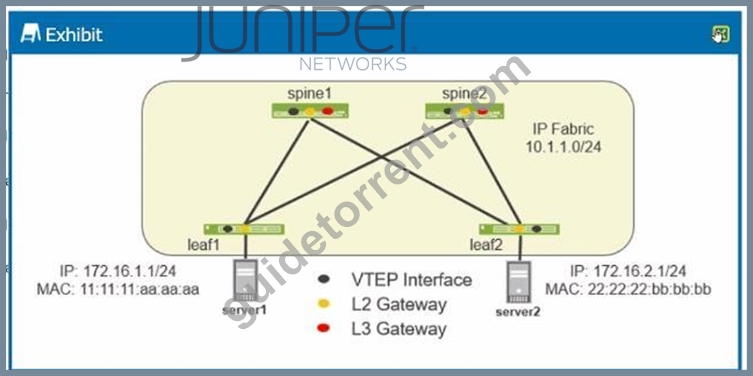
You have implemented an EVPN-VXLAN data center. Device served must be able to communicate with device server2.
Referring to the exhibit, which two statements are correct? (Choose two.)
- A. Traffic from server1 to server2 will transit a VXLAN tunnel to spinel or spine2. then a VXLAN tunnel from spinel or spine2 to Ieaf2.
- B. Traffic from server! to server2 will transit the VXLAN tunnel between leaf1 and Ieaf2.
- C. An IRB interface must be configured on spine1and spine2.
- D. An IRB Interface must be configured on leaf1 and Ieaf2.
Answer: A,C
NEW QUESTION # 39
You are asked to interconnect two of your company's data centers across the IP backbone. Both data centers have their own unique IP space and do not require any bridging. In this scenario, which two actions would accomplish this task? (Choose two.)
- A. Configure a Type 5 EVPN route for each unique prefix.
- B. Configure a Type 2 EVPN route for each unique prefix.
- C. Configure peering for EVPN between all leaf nodes within each data center.
- D. Configure peering for EVPN between border leaf nodes in each data center.
Answer: A,D
Explanation:
* Interconnecting Data Centers:
* The scenario requires interconnecting two data centers with unique IP spaces across an IP backbone. The key point is that bridging is not required, so Layer 3 routing methods must be used.
* EVPN Configuration:
* Option B:Establishing EVPN peering between the border leaf nodes in each data center is the most appropriate solution as it allows for exchanging routing information between the two data centers. This ensures that the routes are properly distributed without the need for L2 bridging.
* Option C:Configuring Type 5 EVPN routes is necessary for advertising IP prefixes (Layer 3 routes) across the EVPN. Type 5 routes allow for the exchange of IP prefixes between the two data centers, enabling the necessary routing functionality without the need for bridging.
Conclusion:
* Option B:Correct-Peering between border leaf nodes sets up the necessary route exchange between data centers.
* Option C:Correct-Type 5 EVPN routes are essential for exchanging Layer 3 prefixes between data centers.
NEW QUESTION # 40
Which two statements are true about IP fabrics using unnumbered BGP? (Choose two.)
- A. Unnumbered BGP peering automatically provisions IPv6 peering.
- B. Unnumbered BGP requires that family inet6 is configured on each interface.
- C. Unnumbered BGP peering automatically provisions IPv4 peering.
- D. Unnumbered BGP requires that family inet is configured on each interface.
Answer: B,C
Explanation:
https://www.juniper.net/documentation/us/en/software/nce/nce-225-bgp-unnumbered/index.html
NEW QUESTION # 41
You are asked to implement VXLAN group-based policies (GBPs) in your data center. Which two statements are correct in (his scenario? (Choose two.)
- A. VXLAN GBP ensures consistent application of security group policies throughout the network.
- B. VXLAN GBP uses scalable group tags that may be configured on a RADIUS server and pushed to the switch through 802.1X.
- C. VXLAN GBP uses scalable group tags thatmust be configured statically on each switch and activated through 802.1X.
- D. VXLAN GBP ensures consistent application of BGP groups throughout the network.
Answer: A,B
Explanation:
* VXLAN Group-Based Policies (GBP):
* VXLAN Group-Based Policies are used to apply security policies consistently across the network. These policies are often tied to user or device identities rather than static IP addresses, which allows for more dynamic and scalable security management.
* Scalable Group Tags via RADIUS and 802.1X:
* Option B:VXLAN GBP can use scalable group tags configured on a RADIUS server, which are then pushed to network devices through 802.1X. This allows for centralized and automated policy application based on user or device identity.
* Consistent Security Policy Application:
* Option C:GBP ensures that security policies are consistently applied across the network, regardless of where a user or device connects. This consistency is crucial in environments where security policies must follow the user or device.
Conclusion:
* Option B:Correct-Group tags can be configured on a RADIUS server and pushed via 802.1X, enabling centralized policy management.
* Option C:Correct-GBP ensures consistent application of security policies, which is essential for maintaining security across a dynamic network environment.
NEW QUESTION # 42
You are deploying an IP fabric with an oversubscription ratio of 3:1.
In this scenario, which two statements are correct? (Choose two.)
- A. The oversubscription ratio remains the same when you add leaf devices.
- B. The oversubscription ratio increases when you remove leaf devices.
- C. The oversubscription ratio decreases when you add leaf devices.
- D. The oversubscription ratio remains the same when you remove leaf devices.
Answer: A,B
Explanation:
* Understanding Oversubscription Ratio in IP Fabrics:
* The oversubscription ratio in an IP fabric typically refers to the ratio of the available bandwidth at the edge of the network (leaves) to the available bandwidth at the core or spine. A 3:1 oversubscription ratio means that for every 3 units of bandwidth at the leaves, there is 1 unit of bandwidth at the spine.
* Impact of Adding or Removing Leaf Devices:
* Removing Leaf Devices:When you remove leaf devices, the amount of total edge bandwidth decreases while the bandwidth in the spine remains constant. This causes the oversubscription ratio toincreasebecause there is now less total bandwidth to distribute across the same amount of spine bandwidth.
* Adding Leaf Devices:Conversely, when you add leaf devices, the total edge bandwidth increases. Since the spine bandwidth remains the same, the oversubscription ratio would remain the same if the additional leaves consume their share of the available bandwidth proportionally.
Conclusion:
* Option C:Correct-Removing leaf devices increases the oversubscription ratio.
* Option D:Correct-Adding leaf devices typically maintains the oversubscription ratio assuming uniform bandwidth distribution.
NEW QUESTION # 43
Which two statements are true about EVPN routes for Data Center Interconnect? (Choose two.)
- A. Type 5 EVPN routes do not require a VXLAN tunnel to the protocol next hop.
- B. Type 2 EVPN routes require a VXLAN tunnel to the protocol next hop.
- C. Type 5 EVPN routes require a VXLAN tunnel to the protocol next hop.
- D. Type 2 EVPN routes do not require a VXLAN tunnel to the protocol next hop.
Answer: A,D
Explanation:
* Type 2 EVPN Routes:
* Type 2 routesadvertise MAC addresses within an EVPN instance and are used primarily for Layer 2 bridging. These routes do not require a VXLAN tunnel to the protocol next hop because they operate within the same Layer 2 domain.
* Type 5 EVPN Routes:
* Type 5 routesare used to advertise IP prefixes (Layer 3 routes) within EVPN. Similar to Type 2 routes, they do not require a VXLAN tunnel to the protocol next hop because they represent L3 routes, which are managed at the routing layer without the need for VXLAN encapsulation.
Conclusion:
* Option B:Correct-Type 2 routes do not need a VXLAN tunnel to the next hop, as they are used for Layer 2.
* Option D:Correct-Type 5 routes also do not need a VXLAN tunnel because they operate at Layer 3, handling IP prefixes.
NEW QUESTION # 44
You are asked for TX and RX traffic statistics for each interface to which an application server is attached.
The statistics need to be reported every five seconds. Using the Junos default settings, which telemetry method would accomplish this request?
- A. gNMI
- B. OpenConfig
- C. Native Sensors
- D. SNMP
Answer: C
Explanation:
* Telemetry Methods in Junos:
* Telemetry is used to collect and report data from network devices. For high-frequency statistics reporting, such as every five seconds, you need a telemetry method that supports this level of granularity and real-time monitoring.
* Junos Native Sensors:
* Option C:Native Sensors in Junos provide detailed, high-frequency telemetry data, including TX and RX traffic statistics for interfaces. They are designed to offer real-time monitoring with customizable sampling intervals, making them ideal for the five-second reporting requirement.
Conclusion:
* Option C:Correct-Native Sensors in Junos are capable of providing the required high-frequency telemetry data every five seconds.
NEW QUESTION # 45
Whatare two ways in which an EVPN-signaled VXLAN is different from a multicast-signaled VXLAN?
(Choose two.)
- A. An EVPN-signaled VXLAN features slower and more complete convergence.
- B. An EVPN-signaled VXLAN can perform autodiscovery of VTEPs using IS-IS.
- C. An EVPN-signaled VXLAN is less resource intensive.
- D. An EVPN-signaled VXLAN can perform autodiscovery of VTEPs using BGP.
Answer: C,D
Explanation:
* Multicast-Signaled VXLAN:
* In traditional multicast-signaled VXLAN, VTEPs (VXLAN Tunnel Endpoints) use multicast to flood and learn about remote VTEPs. This method relies on multicast in the underlay network to distribute BUM (Broadcast, Unknown unicast, and Multicast) traffic.
* This approach can be resource-intensive due to the need for multicast group management and increased network traffic, especially in large deployments.
* EVPN-Signaled VXLAN:
* EVPN-signaled VXLAN uses BGP (Border Gateway Protocol) to signal the presence of VTEPs and distribute MAC address information. BGP is used for VTEP autodiscovery and the distribution of endpoint information.
* This method is more efficient because it reduces the reliance on multicast, instead using BGP control-plane signaling to handle VTEP discovery and MAC learning, which reduces the overhead on the network and improves scalability.
* Correct Statements:
* B. An EVPN-signaled VXLAN can perform autodiscovery of VTEPs using BGP:This is correct because EVPN uses BGP for VTEP autodiscovery, making it more efficient and scalable compared to multicast-based methods.
* C. An EVPN-signaled VXLAN is less resource-intensive:This is correct because it eliminates the need for multicast flooding in the underlay, instead using BGP for signaling, which is less demanding on network resources.
* Incorrect Statements:
* A. An EVPN-signaled VXLAN can perform autodiscovery of VTEPs using IS-IS:This is incorrect because EVPN relies on BGP, not IS-IS, for VTEP discovery and signaling.
* D. An EVPN-signaled VXLAN features slower and more complete convergence:This is incorrect; EVPN with BGP typically provides faster convergence due to its use of a control plane rather than relying on data plane learning.
Data Center References:
* EVPN-VXLAN is widely adopted in modern data center designs due to its scalability, efficiency, and reduced resource consumption compared to multicast-based VXLAN solutions. It leverages the strengths of BGP for control-plane-driven operations, resulting in more efficient and scalable networks.
NEW QUESTION # 46
You want to convert an MX Series router from a VXLAN Layer 2 gateway to a VXLAN Layer 3 gateway for VNI 100. You have already configured an IRB interface. In this scenario, which command would you use to accomplish this task?
- A. set vlans VLAN-100 13-interface irb.100
- B. set protocols isis interface irb.100 passive
- C. set bridge-domains VLAN-100 routing-interface irb.100
- D. set protocols ospf area 0.0.0.0 interface irb.100 passive
Answer: C
NEW QUESTION # 47
Exhibit.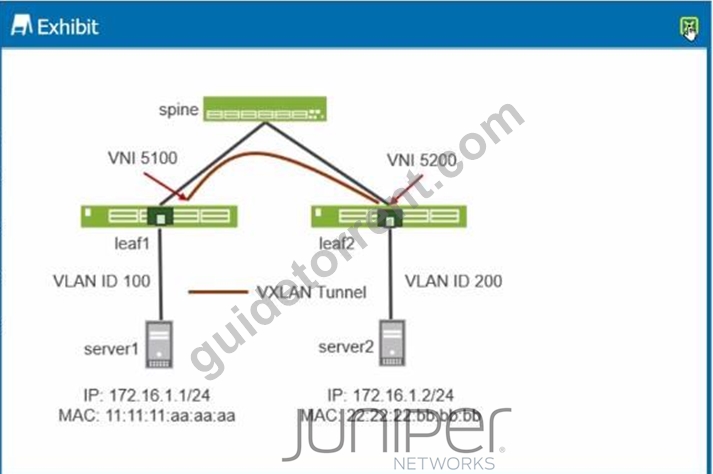
A VXLAN tunnel has been created between leaf1and Ieaf2 in your data center. Referring to the exhibit, which statement is correct?
- A. Traffic sent from server1to server2 will be dropped on leaf1.
- B. Traffic sent from server1to server2 will be tagged with VLAN ID 200 on Ieaf2 and forwarded to server2.
- C. Traffic sent from server1to server2 will be dropped on Ieaf2.
- D. Traffic sent from server1to server2 will be tagged with VLAN ID 100 on Ieaf2 and forwarded to server2.
Answer: B
Explanation:
* Understanding VXLAN Tunneling:
* VXLAN (Virtual Extensible LAN) is a network virtualization technology that addresses the scalability issues associated with traditional VLANs. VXLAN encapsulates Ethernet frames in UDP, allowing Layer 2 connectivity to extend across Layer 3 networks.
* Each VXLAN network is identified by a unique VXLAN Network Identifier (VNI). In this exhibit, we have two VNIs, 5100 and 5200, assigned to the VXLAN tunnels between leaf1 and leaf2.
* Network Setup Details:
* Leaf1:Connected to Server1 with VLAN ID 100 and associated with VNI 5100.
* Leaf2:Connected to Server2 with VLAN ID 200 and associated with VNI 5200.
* Spine:Acts as the interconnect between leaf switches.
* Traffic Flow Analysis:
* When traffic is sent from Server1 to Server2, it is initially tagged with VLAN ID 100 on leaf1.
* The traffic is encapsulated into a VXLAN packet with VNI 5100 on leaf1.
* The packet is then sent across the network (via the spine) to leaf2.
* On leaf2, the VXLAN header is removed, and the original Ethernet frame is decapsulated.
* Leaf2 will then associate this traffic with VLAN ID 200 before forwarding it to Server2.
* Correct Interpretation of the Exhibit:
* The traffic originating from Server1, which is tagged with VLAN ID 100, will be encapsulated into VXLAN and transmitted to leaf2.
* Upon arrival at leaf2, it will be decapsulated, and since it is associated with VNI 5200 on leaf2, the traffic will be retagged with VLAN ID 200.
* Therefore, the traffic will reach Server2 tagged with VLAN ID 200, which matches the network configuration shown in the exhibit.
* Data Center References:
* This configuration is typical in data centers using VXLAN for network virtualization. It allows isolated Layer 2 segments (VLANs) to be stretched across Layer 3 boundaries while maintaining distinct VLAN IDs at each site.
* This approach is efficient for scaling large data center networks while avoiding VLAN ID exhaustion and enabling easier segmentation.
In summary, the correct behavior, as per the exhibit and the detailed explanation, is that traffic sent from Server1 will be tagged with VLAN ID 200 when it reaches Server2 via leaf2. This ensures proper traffic segmentation and handling across the VXLAN-enabled data center network.
NEW QUESTION # 48
Exhibit.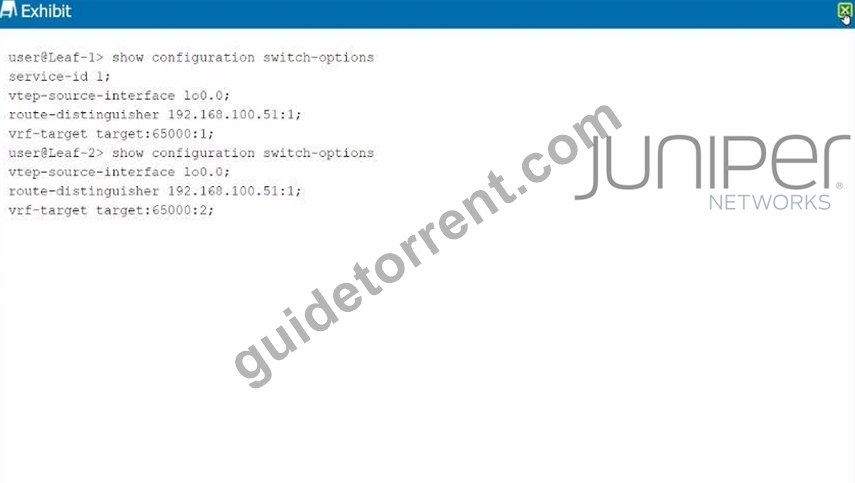
Connections between hosts connected to Leaf-1 and Leaf-2 are not working correctly.
- A. Configure the setswitch-options route-distinguisher i92.168.100.50:i parameter on Leaf-1.
- B. Referring to the exhibit, which two configuration changes are required to solve the problem? (Choose two.)
- C. Configure the setswitch-options vtep-source-interface irb.0parameter on Leaf-1.
- D. Configure the set switch-options vrf-target target:65000:l parameteron Leaf-2.
- E. Configure the setswitch-options service-id 1 parameter on Leaf-2.
Answer: D,E
Explanation:
* Issue Analysis:
* The problem in the exhibit suggests a mismatch in configuration parameters between Leaf-1 and Leaf-2, leading to communication issues between hosts connected to these leaf devices.
* Configuration Mismatches:
* Service-ID:Leaf-1 has service-id 1 configured, while Leaf-2 does not have this parameter. For consistency and proper operation, the service-id should be the same across both leaf devices.
* VRF Target:Leaf-1 is configured with vrf-target target:65000:1, while Leaf-2 is configured with vrf-target target:65000:2. To allow proper VRF import/export between the two leafs, these should match.
* Corrective Actions:
* C. Configure the set switch-options vrf-target target:65000:1 parameter on Leaf-2:This aligns the VRF targets between the two leaf devices, ensuring they can correctly import and export routes.
* E. Configure the set switch-options service-id 1 parameter on Leaf-2:This ensures that both Leaf-1 and Leaf-2 use the same service ID, which is necessary for consistency in the EVPN- VXLAN setup.
Data Center References:
* Correct configuration of VRF targets and service IDs is critical in EVPN-VXLAN setups to ensure that routes and services are correctly shared and recognized between different devices in the network fabric.
NEW QUESTION # 49
Exhibit.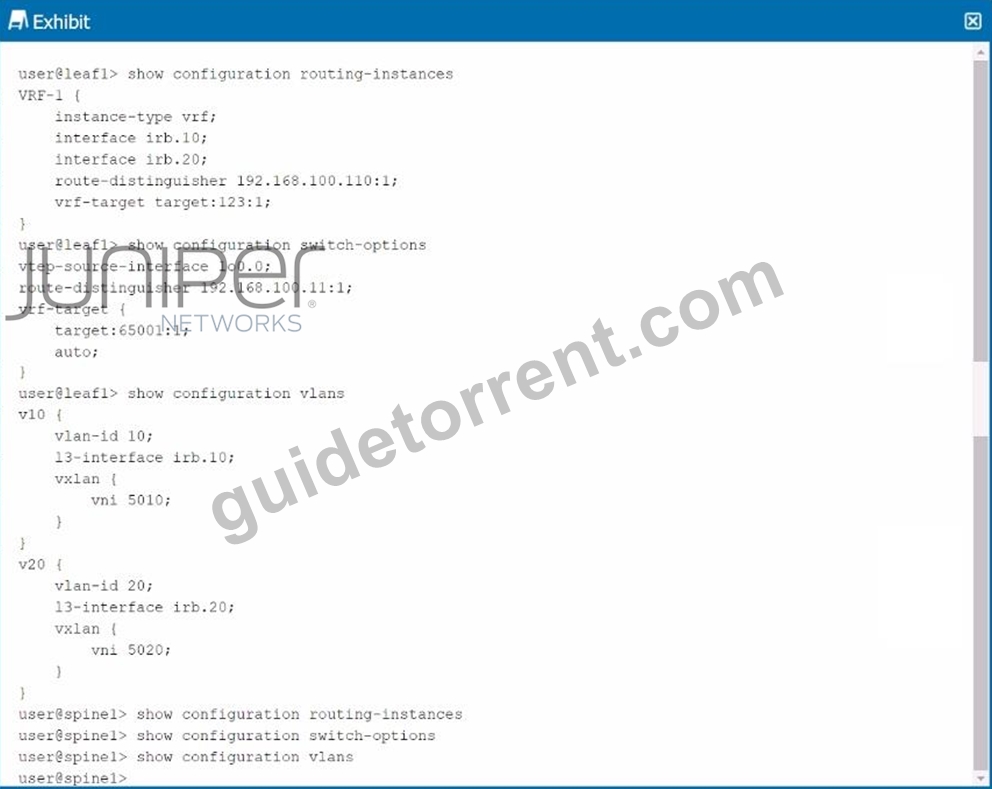
Referring to the exhibit, which statement Is true?
- A. A CRB architecture is being used.
- B. An OTT architecture is being used.
- C. An ERB architecture is being used.
- D. A PBB-EVPN architecture is being used.
Answer: C
Explanation:
* Understanding Network Architectures:
* ERB (Edge Routed Bridging) architecture involves routing at the network's edge (leaf nodes), while traffic between leaf nodes is switched. This is commonly used in VXLAN-EVPN setups.
* Analysis of the Exhibit:
* The exhibit shows configurations related to routing instances, VXLAN, and VLANs, with VNIs being used for each VLAN. This setup is characteristic of an ERB architecture where each leaf device handles Layer 3 routing for its connected devices.
Conclusion:
* Option B:Correct-The configuration shown corresponds to an ERB architecture where routing occurs at the network's edge (leaf devices).
NEW QUESTION # 50
......
Latest JN0-683 Exam Dumps Juniper Exam from Training: https://examcollection.guidetorrent.com/JN0-683-dumps-questions.html