
Accurate Hot Selling HPE7-A08 Exam Dumps 2025 Newly Released
Get 100% Authentic HP HPE7-A08 Dumps with Correct Answers
HP HPE7-A08 Exam Syllabus Topics:
| Topic | Details |
|---|---|
| Topic 1 |
|
| Topic 2 |
|
| Topic 3 |
|
| Topic 4 |
|
NEW QUESTION # 28
Your customer is a large hotel that would like to use a single VLAN per floor and isolate each room's wired network port from the others. Which CX switch feature should you recommend for the simplest solution?
- A. PVLAN
- B. VPN
- C. VXLAN
- D. UBT
Answer: A
Explanation:
To isolate wired ports on the same VLAN on a large scale (such as hotel rooms) but allow communication within the same VLAN for common areas, Private VLANs (PVLANs) are recommended. PVLANs allow segmentation within a single VLAN by dividing it into primary and secondary VLANs, controlling communication between ports.
VPN and VXLAN are overlay technologies for different purposes.
UBT (User-Based Tunneling) is related to wireless user segmentation, not wired port isolation.
Therefore, PVLANs provide the simplest and most effective solution to isolate room ports within a single VLAN.
References:
Aruba Private VLAN Configuration Guide
HPE Aruba VLAN and PVLAN Best Practices
ArubaOS-CX Network Segmentation Documentation
NEW QUESTION # 29
What are best practices when implementing VSX on AOS-CX switches? (Choose two.)
- A. The ISL lag should use at least 10GbE links or faster.
- B. The ISL lag should use the default MTU size.
- C. The default system MAC addresses should be used.
- D. Timers should be left at their default values.
- E. The keepalive connection should use a direct layer-3 connection.
Answer: D,E
NEW QUESTION # 30
Which features are part of Aruba Central?
(Select two.)
Response:
- A. Switch configuration
- B. VLAN monitoring
- C. SD-WAN integration
- D. Intrusion Prevention
Answer: A,C
NEW QUESTION # 31
Which issue can cause high CPU utilization on an Aruba switch?
Response:
- A. Overloaded PoE ports
- B. MSTP misconfiguration
- C. VLAN tagging mismatch
- D. Large broadcast domain
Answer: D
NEW QUESTION # 32
Which methods can be used to configure Aruba switches directly via CLI?
(Select two.)
Response:
- A. Telnet
- B. SSH
- C. Aruba Central
- D. Console connection
Answer: B,D
NEW QUESTION # 33
Which command is used to enable LLDP globally on an Aruba switch?
Response:
- A. enable lldp
- B. lldp activate
- C. lldp enable
- D. lldp run
Answer: D
NEW QUESTION # 34
Refer to the exhibit: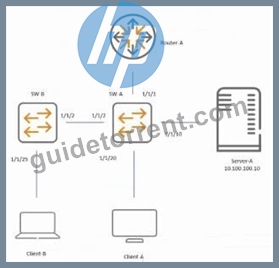
SW-A is the Layer 3 gateway for:
* Server-A in VLAN 100, subnet 10.100.100.0/24
* Client-A in VLAN 20, subnet 10.100.20.0/24
* Client-B in VLAN 30, subnet 10.100.30.0/24
What must be done to prevent rogue DHCP servers in VLAN 30 on SW-B?
- A. Enable dhcpv4-snooping globally and on interface VLAN 30
- B. Enable dhcpv4-snooping authorized-server 10.100.100.10 on VLAN 30
- C. Enable dhcpv4-snooping trust 10.100.100.10 on VLAN 30
- D. Enable snooping globally and on VLAN 30
Answer: B
Explanation:
To prevent rogue DHCP servers in a VLAN, DHCP snooping authorized-server commands are used to specify trusted DHCP servers allowed to respond.
Option A (dhcpv4-snooping trust 10.100.100.10) configures a trusted port, but it is not VLAN specific and not precise enough for this purpose.
Enabling DHCP snooping globally and on VLAN or interface (Options C and D) are prerequisites but do not prevent rogue servers unless authorized servers are defined.
Option B correctly enables an authorized DHCP server IP on VLAN 30, blocking unauthorized DHCP responses.
References:
ArubaOS-CX DHCP Snooping Configuration Guide
HPE Aruba Network Security Best Practices
Aruba DHCP Snooping Technical Whitepaper
NEW QUESTION # 35
Your customer's CX switches are managed in HPE Aruba Networking Central. If a VSX primary switch is accidentally powered off, which alert will be triggered?
- A. Switch Disconnected
- B. Switch Reboot
- C. Switch STP Root Change
- D. Switch Stack Conductor Change
Answer: A
Explanation:
When a VSX primary switch is powered off, it loses connectivity with management systems such as HPE Aruba Central. This causes the management system to trigger a "Switch Disconnected" alert because the switch is no longer reachable.
"Switch Reboot" alerts would indicate a restart, not power off.
"Switch Stack Conductor Change" refers to stack leadership changes, not VSX primary down.
"Switch STP Root Change" relates to Spanning Tree Protocol root bridge changes.
Hence, powering off the VSX primary causes a "Switch Disconnected" alert.
References:
HPE Aruba VSX Management and Monitoring Guide
Aruba Central Documentation on Alerts and Events
ArubaOS-CX VSX Best Practices
NEW QUESTION # 36
A network administrator is implementing OSPF, where there are two exit points. Each exit point has a stateful, application inspection firewall to implement company policies.
What would the best practice be to ensure that one firewall will see both directions of the traffic, preventing asynchronous connections in the network?
- A. Both ASBRs should define External Type 1 routes for the external routes, using a different initial cost value for each ASBR.
- B. Both ASBRs should define External Type 2 routes for the external routes, using the same initial cost value for each ASBR.
- C. Both ASBRs should define External Type 2 routes for the external routes, using a different initial cost value for each ASBR.
- D. Both ASBRs should define External Type 1 routes for the external routes, using the same initial cost value for each ASBR.
Answer: A
NEW QUESTION # 37
Which multicast protocol is recommended for enterprise networks?
Response:
- A. MPLS
- B. LACP
- C. OSPF
- D. IGMP
Answer: D
NEW QUESTION # 38
When comparing PIM-DM and PIM-SM, which multicast components are only found with PIM-SM in multicast routing? (Choose two.)
- A. Bootstrap router
- B. Designated router
- C. Rendezvous point
- D. IGMP querier
- E. Shortest path tree
Answer: C,E
NEW QUESTION # 39
What is the most likely cause of an IP conflict on a network?
Response:
- A. Spanning Tree Protocol failure
- B. Two devices using the same static IP address
- C. Incorrect subnet mask configuration
- D. Duplicate MAC addresses
Answer: B
NEW QUESTION # 40
Refer to the exhibit from an HPE Aruba Networking CX6000:
Two CX 6000 switches are configured with the same configuration for LAG 1. What needs to be done to remove the LACP block state?
- A. Change the LACP mode from passive to active on one of the switches
- B. On one of the switches, change the LACP mode to passive
- C. Change the LACP mode from passive to static on one of the switches
- D. On both of the switches, change the LACP timeout to short
Answer: A
Explanation:
LACP (Link Aggregation Control Protocol) modes can be active or passive. When two switches are both configured in passive mode, no LACP packets are initiated, causing the link aggregation to fail or go into a block state.
Changing one side from passive to active causes that switch to initiate LACP negotiation, resolving the block state.
Changing to static mode disables LACP negotiation, which is not recommended unless both sides are static.
Changing timeout does not solve LACP block issues caused by mode mismatches.
Therefore, changing one switch's LACP mode from passive to active is necessary to resolve the block.
References:
ArubaOS-CX LACP Configuration Guide
IEEE 802.3ad Standard for LACP
Aruba VSX and LACP Troubleshooting Guide
NEW QUESTION # 41
A company has implemented 802.1X authentication on AOS-CX access switches, where two ClearPass servers are used to implement AAA. Each switch has the two servers defined. A network engineer notices the following command configured on the AOS-CX switches:
radius-server tracking user-name monitor password plaintext aruba123
What is the purpose of this configuration?
- A. Implement replay protection for AAA messages
- B. Define the account to implement downloadable user roles
- C. Define the account to implement change of authorization
- D. Speed up the AAA authentication process
Answer: D
Explanation:
Radius service tracking locates the availability of the RADIUS service configured on the switch. It helps to minimize the waiting period for new clients in the unauth-vid (Guest Vlan) when authentication fails because of service is not available, as well as previously authenticated clients in unauth-vid (Guest Vlan) when re-authentication fails because service is not available during the re-authentication period.
Note that this feature is disabled by default.
radius-server tracking
Syntax
[no] radius-server tracking <enable|disable>
NEW QUESTION # 42
Which configurations enhance multicast traffic efficiency on Aruba switches?
(Select two.)
Response:
- A. Disabling STP
- B. Configuring static routes
- C. Implementing PIM
- D. Enabling IGMP snooping
Answer: C,D
NEW QUESTION # 43
You have run a script to configure a new VLAN on a CX switch, but are receiving a '404 - Not Found' HTTP response code.
What do you need to do to resolve the issue?
- A. Specify the /rest/v1/system/vlan URI in the request.
- B. Enable the switch REST API in read/write mode.
- C. Send a POST request to the /rest/v1/login resource.
- D. Correct syntax error contained in the data payload.
Answer: A
Explanation:
When receiving a '404 - Not Found' HTTP response while attempting to configure a VLAN via REST API, the most common cause is specifying an incorrect URI endpoint. The correct approach is to specify the exact resource path for VLAN configuration, which is /rest/v1/system/vlan. Without the correct URI, the API will return a 404 error indicating the resource is not found.
Sending a POST request to login is necessary but not related to 404 after login.
Syntax errors in payload lead to 400-series errors but usually not 404.
Enabling REST API read/write is important but would result in different errors.
References:
ArubaOS-CX REST API Developer Guide
HPE Aruba Networking REST API Documentation
Aruba CX Switch RESTful API Examples
NEW QUESTION # 44
What is the correct way of associating a VRF instance to either a VLAN or an interface?
- A. Switch(config)# vlan <VLAN-ID> vrf attach < vrf-name >
- B. Switch(config)# vlan <VLAN-ID> vrf < vrf-name >
- C. Switch(config)# vlan <VLAN-ID>
Switch(config-vlan-<VLAN-ID># vrf attach < vrf-name > - D. Switch(config)# interface <interface-ID>
Switch(config-if)# vlan access <VLAN-ID> vrf attach <vrf-name>
Answer: C
NEW QUESTION # 45
Which HPE Aruba tool is used for provisioning switches in a cloud-managed environment?
Response:
- A. AirWave
- B. NetEdit
- C. Aruba Central
- D. ClearPass
Answer: C
NEW QUESTION # 46
Which issue can occur if an incorrect VLAN is assigned to a switch port?
Response:
- A. End device unable to reach the correct network
- B. Broadcast storm
- C. Loop formation
- D. IP address conflict
Answer: A
NEW QUESTION # 47
Examine the attached diagram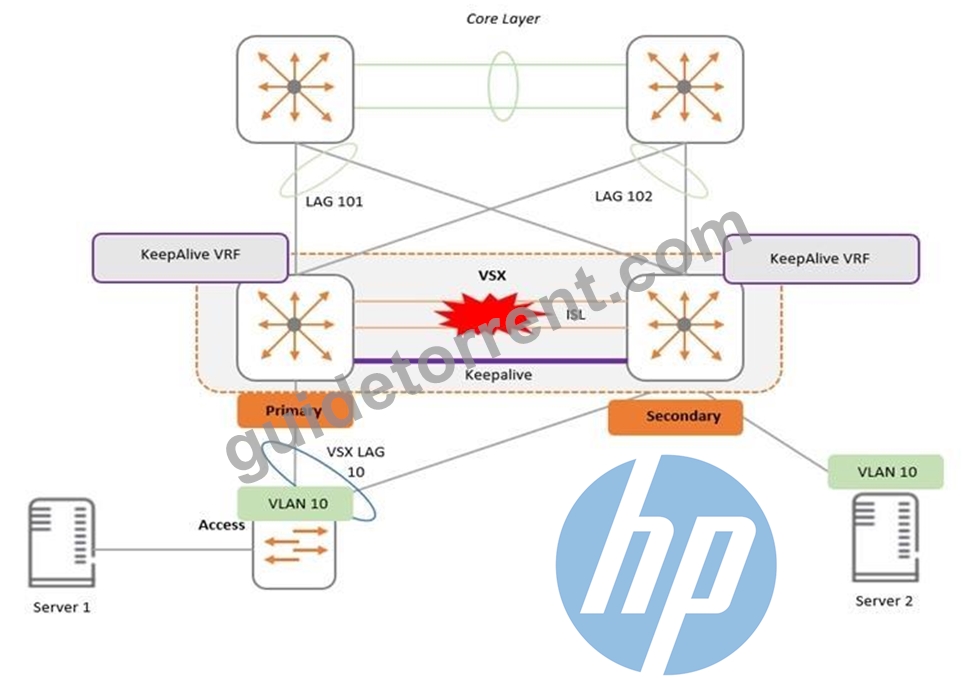
Two AOS-CX switches are configured for VSX at the access layer, where servers attached to them. An SVI interface is configured for VLAN 10 and serves as the default gateway for VLAN 10.
The ISL link between the switches fails, but the keepalive interface functions. Active gateway has been configured on the switches.
What is correct about access from the servers to the Core?
- A. Server 2 can successfully access the core layer via the keepalive link.
- B. Server 1 and Server 2 can communicate with each other via the core layer.
- C. Server 1 can access the core layer via both uplinks.
- D. Server 2 cannot access the core layer.
Answer: C
NEW QUESTION # 48
Which Aruba tool allows for automated configuration deployment across multiple switches?
Response:
- A. AirWave
- B. Aruba Central
- C. Wireshark
- D. NetEdit
Answer: D
NEW QUESTION # 49
An HPE Aruba Networking CX switch is configured with IGMP using the given output: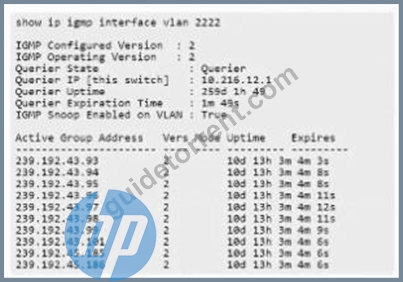
Which statement is true about the possible supported message types?
- A. Query and Report
- B. Leave and Report
- C. Join, Leave, Query and Report
- D. Join and Query
Answer: C
Explanation:
IGMP (Internet Group Management Protocol) supports several message types: Join, Leave, Query, and Report messages to manage multicast group membership.
Join messages indicate a host wants to join a multicast group.
Leave messages indicate a host is leaving a multicast group.
Query messages are sent by routers to discover group members.
Report messages are sent by hosts to indicate membership.
Therefore, the full set of IGMP message types supported includes Join, Leave, Query, and Report.
Options with only Leave and Report or only Join and Query are incomplete.
References:
RFC 2236 (IGMPv2) and RFC 3376 (IGMPv3)
HPE Aruba CX Multicast Configuration and IGMP Snooping Guide
ArubaOS-CX Network Protocols Manual
NEW QUESTION # 50
An administrator is managing a network comprised of AOS-CX switches deployed at the aggregation layer. The switches are paired in a VSX stack and run the OSPF routing protocol.
The administrator is concerned about how long it takes for OSPF to converge when one of the VSX switches has to reboot.
What should the administrator to do speed up the OSPF convergence of the switch that is rebooting?
- A. Define non-backbone areas on the VSX switches as totally stubby areas.
- B. Implement graceful restart on the VSX switches and their neighboring OSPF switches.
- C. Change the VSX ISL link from an OSPF broadcast link point-to-point.
- D. Decrease the VSX initial synchronization timer on the two VSX switches.
Answer: B
NEW QUESTION # 51
......
Dumps of HPE7-A08 Cover all the requirements of the Real Exam: https://examcollection.guidetorrent.com/HPE7-A08-dumps-questions.html