


Palo Alto Networks revises its exams from time to time, and outdated material can sink a well-prepared candidate. Every PCCP purchase at GuideTorrent includes 365 days of free updates, keeping your Palo Alto Networks Certified Cybersecurity Practitioner practice questions aligned with the current exam outline in 2026.
Palo Alto Networks PCCP Exam Syllabus Topics:
| Section | Weight | Objectives |
|---|---|---|
| Topic 1: Cybersecurity Fundamentals | 24% | - Security technologies: IAM, MFA, email security - Core security principles: confidentiality, integrity, availability - Access control frameworks: AAA, Zero Trust - Threat landscape: actors, vectors, MITRE ATT&CK, APT |
| Topic 2: Cloud Security & Secure Access | 19% | - Prisma Cloud: cloud security and compliance - Prisma Access, SD-WAN, DLP, CASB, SWG - Cloud service models: IaaS, PaaS, SaaS - SASE / SSE concepts and architecture |
| Topic 3: Security Operations | 16% | - SOC functions: monitoring, alerting, incident response - Threat hunting and Unit 42 intelligence - SIEM, SOAR, ASM platforms and use cases - Cortex XSOAR, Xpanse, XSIAM overview |
| Topic 4: Network Security | 22% | - Security policies, NAT, VPN, user identification - PAN-OS core features and management - Next-Generation Firewall (NGFW) architecture and deployment - Network segmentation and threat prevention |
| Topic 5: Endpoint Security | 19% | - Host-based security: firewall, IPS, application control - Cortex XDR: detection, response, and prevention - Device management: MDM, compliance, patch management - Endpoint threats and defense strategies |
PCCP Exam FAQ: What Candidates Ask Most
The Palo Alto Networks PCCP exam, officially titled Palo Alto Networks Certified Cybersecurity Practitioner, is the required test for earning the Palo Alto Networks Certified Cybersecurity Practitioner certification, a credential at the Associate level. Passing it validates the skills Palo Alto Networks expects from certified professionals, and it can also support progress toward related credentials such as Palo Alto Networks Certified Cybersecurity Entry-level Technician (PCCET), Palo Alto Networks Certified Network Security Administrator (PCNSA).
The PCCP exam includes 65-75 questions, and you have 80-90 to complete it. Before exam day, divide the available time by the question count so you know the pace you need to hold, and practice flagging time-consuming items for review instead of stalling on a single question. Timed sessions in the GuideTorrent test engine are the easiest way to build that rhythm before it counts.
You need 860/1000 to pass the PCCP exam, and the official registration fee is 150 USD. Keep in mind that a failed attempt means paying that fee in full again for a retake, so avoid booking your seat on a hunch. Work through the GuideTorrent practice test until your scores sit comfortably above the passing requirement before you schedule the exam.
Palo Alto Networks asks candidates to meet the following requirement before registering: No mandatory prerequisites; recommended basic knowledge of networking and security concepts. Exam policies do change, so confirm the latest details on the official exam page at https://www.paloaltonetworks.com/services/education/panw-cybersecurity-practitioner before you book.
You can book your seat through the official registration channels below:
The PCCP exam is delivered in the following format: Onsite testing at Pearson VUE centers; no online proctoring.
Palo Alto Networks recommends the following official training for this exam:
A course builds the theory; practice turns it into exam-day performance. Once you finish a class, the 227 practice questions from GuideTorrent show you how the same knowledge appears in exam-style items.
Yes. GuideTorrent offers a free PDF demo of the Palo Alto Networks Certified Cybersecurity Practitioner practice questions, so you can judge the quality and format before purchasing. After you buy, your purchase includes 365 days of free updates; if the product expires after that period, you can extend the update service at a 50% discount from your member zone.
Every GuideTorrent order is covered by a 100% Money Back Guarantee. If you take the corresponding PCCP exam within 60 days of purchase and do not pass, send a scan of your exam enrollment slip together with your official Score Report PDF within two days of the exam date, and your claim will be processed within seven days. The candidate name must match the payer name, and the guarantee does not apply if you take the exam within three days of purchase, if you downloaded the product but never took the exam, or to free materials and expired orders. If you would rather have fresh material than a refund, you can exchange your purchase for two additional exam products of equal value at no cost and keep the update service on your original product. Delivery itself is instant: your download is available right after payment and a copy is emailed to you within one minute — if nothing arrives within two hours, contact our support team. You may install the software on as many computers as you need.
The Palo Alto Networks Certified Cybersecurity Practitioner exam is organized into 5 major domains. Some of the key domains include:
- Cybersecurity Fundamentals, accounting for 24% of the exam
- Cloud Security & Secure Access, accounting for 19% of the exam
- Network Security, accounting for 22% of the exam
Scroll up to the Exam Topics section for the complete breakdown, and use it to plan how much study time each domain deserves.
Palo Alto Networks Certified Cybersecurity Practitioner Sample Questions:
Match the Palo Alto Networks WildFire analysis verdict with its definition.
Correct Answer:
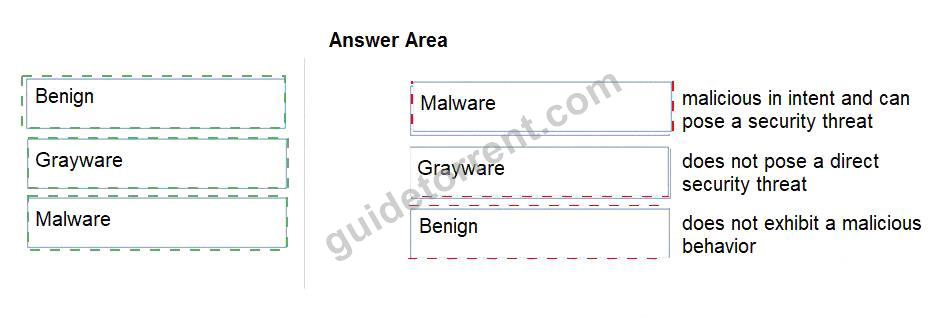
Explanation:
# Benign: Safe and does not exhibit malicious behavior
# Grayware: No security risk but might display obtrusive behavior (for example, adware, spyware, and browser helper objects)
# Malware: Malicious in nature and intent and can pose a security threat (for example, viruses, worms, trojans, root kits, botnets, and remote-access toolkits)
# Phishing: Malicious attempt to trick the recipient into revealing sensitive data
Why have software developers widely embraced the use of containers?
- A. Containers are host specific and are not portable across different virtual machine hosts.
- B. Containers require separate development and production environments to promote authentic code.
- C. Containers simplify the building and deploying of cloud native applications.
- D. Containers share application dependencies with other containers and with their host computer.
Correct Answer: C 🗳️
Explanation: Only visible for GuideTorrent members. You can sign-up / login (it's free).


Which Palo Alto Networks tools enable a proactive, prevention-based approach to network automation that accelerates security analysis?
- A. Cortex XDR
- B. AutoFocus
- C. MineMeld
- D. WildFire
Correct Answer: A 🗳️
Explanation: Only visible for GuideTorrent members. You can sign-up / login (it's free).
Which feature is part of an intrusion prevention system (IPS)?
- A. Automated security actions
- B. API-based coverage of apps
- C. Protection of data at rest
- D. Real-time web filtering
Correct Answer: A 🗳️
Explanation: Only visible for GuideTorrent members. You can sign-up / login (it's free).
Viewing page 1 out of 46 pages.
Viewing questions 1-5 out of 227 questions.


